What Is a Multi-Page Website? A Small Business Guide
A multi-page website uses distinct pages with unique URLs to boost SEO, improve UX, and generate more leads. Here is what small businesses need to know.
A multi-page website is defined as a site built from multiple distinct pages, each with its own unique URL, connected through a shared navigation menu. Think of it as a well-organized office building where every room has a clear purpose. The most common pages include Home, About, Services, Blog, and Contact. For small business owners and coaches, understanding what a multi-page website offers is the first step toward building an online presence that actually works. This structure supports better SEO, cleaner user experience, and real room to grow.
What are the key benefits of a multi-page website for businesses?
A multi-page website gives your business more surface area online. Every separate page targets its own keywords, which means Google has more entry points to find and rank your content. That directly translates to more organic traffic without paying for ads.
The advantages of multi-page websites go well beyond search rankings:
- SEO reach: Each page can rank for a different search term. A Services page targets "life coaching packages," while a Blog post targets "how to find a life coach." You are not cramming everything onto one page and hoping for the best.
- User experience: Visitors find what they need faster when content is organized by topic. A cluttered single page forces people to scroll endlessly. Separate pages let you guide visitors step by step.
- Lead generation: Companies with 30 or more landing pages generate 7x more leads than those with fewer than 10 pages. More pages mean more opportunities to capture interest and convert visitors into clients.
- Scalability: You can add a new service page, a case study, or a resource library without rebuilding your entire site. Growth is additive, not disruptive.
- AI discoverability: Multi-page websites perform better for AI search engines because structured content creates clearer semantic relationships. AI tools like Perplexity and ChatGPT favor sites that organize information into distinct, authoritative topic clusters.
Pro Tip: If you are a coach, treat each service you offer as its own page. A dedicated "Health Coaching" page and a separate "Finance Coaching" page will each rank independently, doubling your chances of being found.
How does a multi-page website compare to a single-page website?

A single-page website places all content on one continuous scrolling page. It works well for a product launch, a personal portfolio, or a very early-stage business that needs something live fast. The tradeoff is real, though. Single-page websites limit long-term SEO growth because all content competes for the same keyword space and there are no separate URLs to rank.
Here is a direct comparison of the two structures:
| Feature | Multi-page website | Single-page website |
|---|---|---|
| SEO potential | High. Each page targets unique keywords. | Low. One URL, limited keyword range. |
| Navigation | Menu links to distinct pages. | Anchor links scroll within one page. |
| Content depth | Unlimited. Add pages as you grow. | Constrained by page length. |
| Lead generation | Multiple landing pages capture varied intent. | One conversion point for all visitors. |
| Best for | Established businesses, coaches, service providers. | MVPs, portfolios, event pages. |
Marketing specialists confirm that single-page sites serve niche or early-stage needs, but multi-page architecture is required for long-term organic growth. If you are building a coaching practice or a small business with multiple services, a multi-page structure is not optional. It is the foundation.
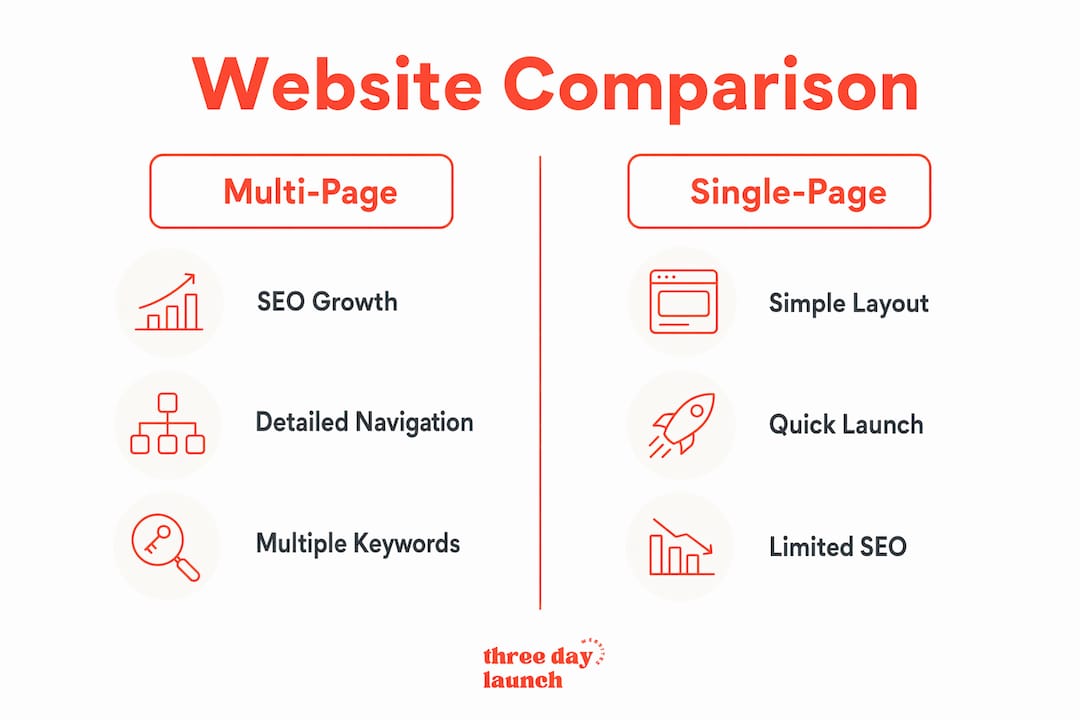
The navigation experience also differs significantly. On a multi-page site, clicking "Services" loads a fresh page with its own title tag, meta description, and content. Search engines treat that as a separate document. On a single-page site, clicking "Services" just scrolls the browser down. Google sees it all as one document. That distinction matters enormously for how you rank.
What are best practices for creating a multi-page website?
Good website architecture does not happen by accident. It requires planning before you write a single line of code or drag a single block in a website builder. Here is how to build a multi-page site that holds up over time.
-
Plan your sitemap first. Map out your core pages before you build anything. Upfront sitemap planning reduces technical debt by 50–80% and leads to better UX and SEO from day one. Start with Home, About, Services, Blog, and Contact. Add more only when you have content to fill them.
-
Manage navigation centrally. Hardcoding navigation on every page leads to heavy maintenance headaches. Use a CMS or server-side includes so one edit updates every page at once. This prevents the nightmare of updating 20 pages manually every time you add a service.
-
Keep files in the root folder. Placing pages in the root folder simplifies relative paths for shared resources like CSS and images. Deep folder nesting creates broken links as your site grows. Flat structure wins.
-
Use accessible navigation markup. Adding the
aria-current="page"attribute to your active navigation link tells screen readers which page the visitor is on. Accessibility is not just ethical. It also signals quality to search engines.
-
Reuse layouts and templates. Consistent headers, footers, and page structures reduce build time and make your site feel cohesive. Visitors trust sites that look intentional and organized.
-
Test all links regularly. Broken navigation is one of the fastest ways to lose a visitor's trust. Schedule a monthly link check, especially after adding new pages or restructuring content.
Pro Tip: Before you build, sketch your navigation menu on paper. If a visitor cannot find any page within two clicks from the homepage, your structure needs simplifying.
What content strategies maximize a multi-page site's marketing impact?
Building the pages is only half the job. Filling them with content that converts visitors into clients is where the real work happens. A well-designed multi-page website structure becomes your most consistent lead generation tool when the content strategy is right.
Here is what works:
- Pillar and cluster content model. Create one authoritative pillar page on a broad topic, then build supporting cluster pages around subtopics. A health coach might have a pillar page on "wellness coaching" and cluster pages on "stress management," "sleep coaching," and "nutrition guidance." This signals deep topical authority to search engines.
- Keyword-specific pages. Multi-page websites allow targeting multiple keywords through separate optimized pages. Each page should have one primary keyword, one clear message, and one call to action.
- Multiple calls to action. Do not rely on your Contact page alone. Add a "Book a Free Call" button on your Services page, a lead magnet on your Blog, and a testimonial section on your About page. Every page is a conversion opportunity.
- Analytics-driven adjustments. Use Google Analytics or a similar tool to see which pages get traffic and which get ignored. Double down on what works. Rewrite or remove what does not.
- User journey mapping. Think about where a visitor lands and where you want them to go next. A blog reader should have a clear path to your Services page. A Services visitor should have an easy route to your Contact page.
Let's Launch Your Strategic Coaching Website
Your first step is to book a free call so we can get your questions answered.
Book A Free CallPro Tip: Add internal links between related pages. A blog post about "how to find a life coach" should link directly to your Life Coaching Services page. This keeps visitors on your site longer and signals content relationships to Google.
For coaches specifically, website elements that attract clients include clear service descriptions, social proof, and a frictionless booking process. All of these work best when spread across dedicated pages rather than compressed into one. You can also look at high-converting coach website examples to see how effective multi-page structures look in practice.
Key Takeaways
A multi-page website is the most effective structure for small businesses and coaches who want sustainable SEO growth, organized content, and consistent lead generation.
| Point | Details |
|---|---|
| Definition | A multi-page site uses distinct pages with unique URLs, each targeting specific content and keywords. |
| SEO advantage | Separate pages rank for different search terms, expanding your organic reach significantly. |
| Lead generation | Sites with 30 or more pages generate 7x more leads than those with fewer than 10 pages. |
| Architecture basics | Plan your sitemap first, manage navigation centrally, and keep files in the root folder. |
| Content strategy | Use pillar and cluster pages, keyword-specific content, and multiple calls to action across pages. |
Why I think multi-page sites are non-negotiable for growing businesses
We have worked with coaches across life, health, and finance, and the pattern is consistent. The ones who launch with a single page because it felt "simpler" come back six months later frustrated that their site is not generating leads. The ones who start with a proper multi-page structure, even a lean five-page version, see organic traffic build steadily from month one.
The SEO landscape in 2026 has made this even more clear. AI search tools now favor sites that organize information into structured, interconnected topic clusters. A single-page site looks thin to both Google and AI engines. A multi-page site looks like a credible knowledge source. That distinction is the difference between being found and being invisible.
The most common mistake I see is poor navigation planning. Coaches add pages as an afterthought, creating a messy structure that confuses visitors and search engines alike. The fix is simple: plan your sitemap before you build anything. Know exactly what pages you need and how they connect. That 30 minutes of planning saves weeks of rework later.
If you are a small business owner or coach building your first site, do not let the word "multi-page" intimidate you. You do not need 50 pages. You need five good ones, built with intention, connected clearly, and filled with content that speaks directly to your ideal client. Start there, and grow from it.
Your multi-page website, built in three days
Getting a custom multi-page website built used to mean months of waiting and thousands of dollars. Three Day Launch changes that entirely.
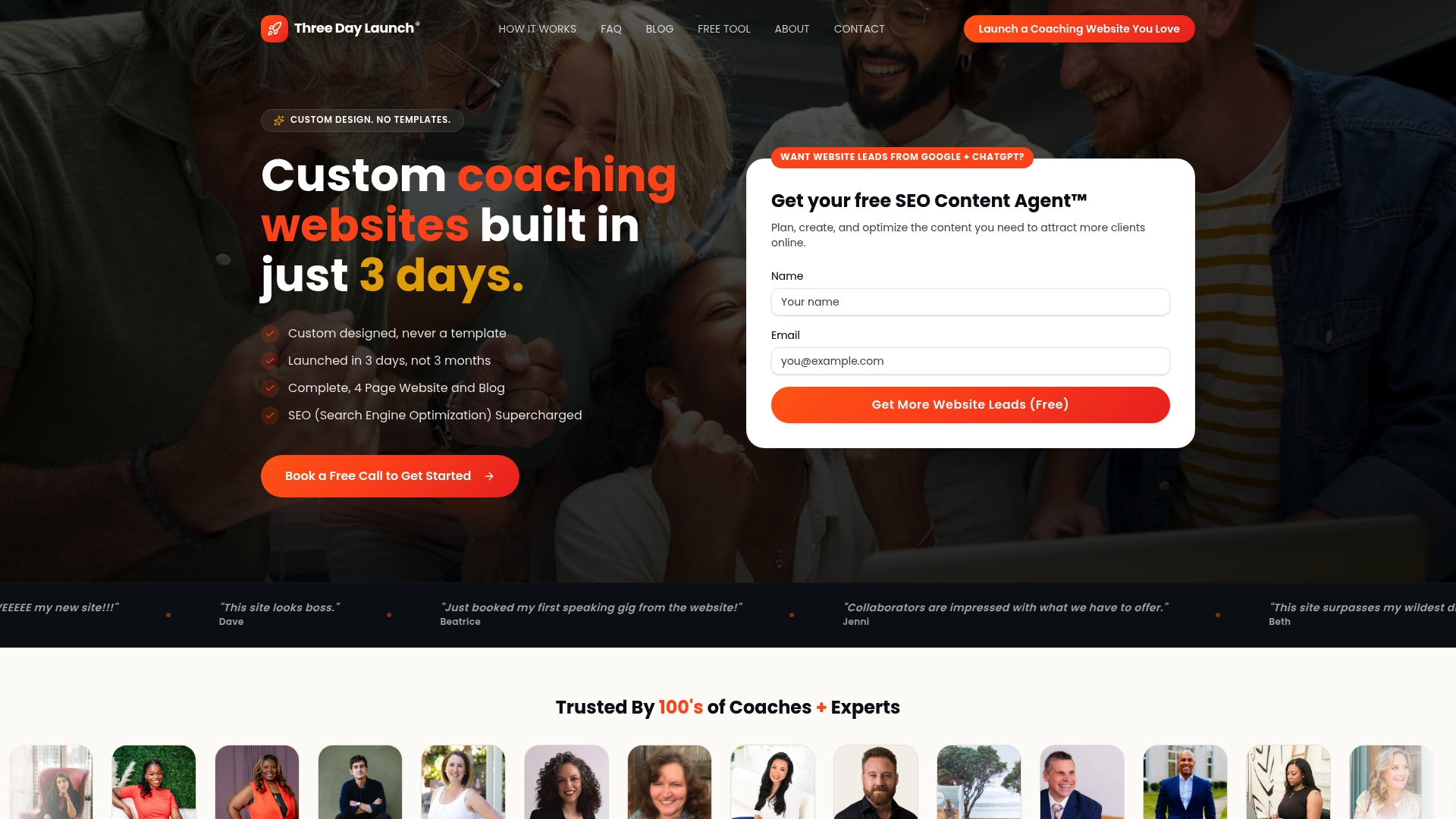
Three Day Launch specializes in custom multi-page websites for coaches, built and launched in just three days. Every site includes a clear page structure, conversion-focused design, and content organized to attract and book clients. Coaches in life, health, and finance have seen real results, including significant increases in organic traffic and client inquiries, shortly after launch. If you are ready to build a site that works as hard as you do, Three Day Launch is the place to start.
FAQ
What is a multi-page website in simple terms?
A multi-page website is a site with multiple separate pages, each with its own URL, connected through a navigation menu. Common pages include Home, About, Services, Blog, and Contact.
How many pages does a multi-page website need?
A functional multi-page site can start with as few as five pages. Companies with 30 or more pages generate significantly more leads, so adding pages as your business grows is the right approach.
Is a multi-page website better for SEO than a single-page site?
Yes. Multi-page websites allow each page to target different keywords, which expands your search engine footprint. Single-page sites compress all content into one URL, which limits keyword reach and long-term ranking potential.
What pages should a small business website include?
Start with Home, About, Services, Blog, and Contact. Each page should have a clear purpose, a primary keyword, and a call to action that guides visitors toward booking or reaching out.
Can I add pages to my website after it launches?
Yes, and you should. Multi-page website structure is designed for growth. Adding new service pages, blog posts, or resource pages over time builds topical authority and increases your chances of ranking for more search terms.