Website Elements That Attract Coaching Clients in 2026
The website elements that attract coaching clients in 2026: clear niche statement, visible credentials, outcome-focused testimonials, direct booking, and transparent pricing.

Your website is your storefront, your handshake, and your first pitch to every potential client. The website elements that attract coaching clients are specific, proven features: a clear niche statement, visible credentials, outcome-focused testimonials, a direct booking path, and transparent service pages. Get these right, and your site works for you around the clock. Miss them, and even great coaches lose clients to competitors with sharper online presence.
1. Why a clear niche statement is the most important element
A homepage that states your niche and outcome within 5 seconds keeps visitors engaged and reduces bounce rates. That 5-second window is not a suggestion. It is the difference between a visitor who reads on and one who hits the back button.
Vague messaging kills conversions. Compare these two examples:
- Vague: "I help people live their best lives."
- Focused: "I help mid-career professionals land director-level roles in 90 days."
The second version tells a specific person, with a specific problem, that they are in the right place. Coaching clients look for messaging that names the problems you solve in direct and specific terms. Specificity signals expertise. It also filters out poor-fit leads before they ever book a call.
Pro Tip: Write your homepage headline as a single sentence: "I help [specific person] achieve [specific outcome] in [timeframe]." Test it by asking someone outside your industry if they understand it in under 10 seconds.

Your niche statement belongs above the fold, meaning visible before any scrolling. Do not bury it in your About page. Put it front and center where every visitor sees it immediately.
2. How prominently displaying credentials builds client trust
73% of coaching clients expect their coach to hold a recognized certification displayed prominently on the website. That number means most visitors are actively looking for proof before they consider booking. If they cannot find it quickly, they assume it is not there.
Credentials from the International Coaching Federation, such as ACC, PCC, or MCC designations, carry real weight with informed buyers. Place them above the fold on your homepage, not buried in a footer or tucked inside a long About page. Visibility matters as much as the credential itself.
Here is where to display your credentials for maximum impact:
- Homepage hero section: Right below or beside your name and niche statement
- About page header: The first thing visitors see when they click to learn more about you
- Service pages: Reinforce trust at the exact moment a visitor is deciding to book
- Email signature and booking confirmation pages: Extend credibility beyond the website itself
Coaches who hide their certifications out of modesty are leaving trust on the table. A credential badge or a simple line that reads "ICF PCC Certified" next to your name does not feel like bragging. It feels like reassurance to a client who is about to invest real money in your services.
3. Using specific client testimonials to convert hesitant visitors
Video testimonials outperform text testimonials, and specific client outcomes convert better than vague praise. "Sarah was amazing and changed my life" does not move the needle. "After six sessions with Sarah, I negotiated a $22,000 salary increase and accepted a director role" does.
Outcome-focused testimonials do two things at once. They show results, and they help prospective clients picture themselves achieving similar wins. That mental image is what turns a browser into a booker.
Pro Tip: When asking clients for testimonials, give them a simple prompt: "What was your situation before we worked together, what changed, and what specific result did you achieve?" This structure produces the kind of testimonials that actually convert.
A few guidelines for testimonial content that works:
- Include the client's first name, last initial, and their role or industry for credibility
- Use a photo when possible. A face makes the testimonial feel real, not fabricated.
- Aim for at least one video testimonial on your homepage. Even a 60-second clip recorded on a phone outperforms a wall of text quotes.
- Avoid editing out the specifics. Numbers, timelines, and named outcomes are what build trust.
Place your strongest testimonial directly below your homepage hero section. Do not save it for a dedicated testimonials page that most visitors will never find.
4. Streamlining the booking process with direct discovery call links
Coaching clients who book a discovery call through a direct, automated booking link convert to paying clients at roughly 25%. That is a meaningful conversion rate, and it depends entirely on removing friction from the booking process.
A vague "contact me" form is friction. It asks the visitor to wait for a reply, wonder if you got their message, and then coordinate schedules through back-and-forth emails. Tools like Calendly and Acuity Scheduling eliminate all of that. The visitor picks a time, confirms, and receives an automatic reminder. The process takes under two minutes.
Here is how to set up a booking path that actually converts:
- Use a direct booking link, not a contact form, as your primary CTA on every page
- Label the CTA clearly: "Book a Free Discovery Call" outperforms "Get in Touch" every time
- Place the CTA in your navigation bar so it is visible on every page without scrolling
- Repeat the CTA at the bottom of every service page to catch visitors who read all the way through
Multiple CTAs with inconsistent wording dilute conversion momentum. Pick one phrase and use it everywhere. Consistency reduces decision fatigue and keeps visitors moving toward the booking. You can learn more about CTA placement strategy for coaching sites to get the details right.
5. Why transparent service pages qualify leads and speed decisions
Hiding pricing creates friction. Listing clear prices qualifies leads immediately, attracting financially ready clients and saving your time. A visitor who sees your pricing and books anyway is a serious prospect. A visitor who books without knowing your pricing often becomes a wasted discovery call.
Your service pages need to answer four questions without making visitors dig:
| Question | What to include |
|---|---|
| What is the package called? | A clear, descriptive name (not "Package A") |
| How long does it run? | Session count, duration, and total program length |
| What is included? | Specific deliverables, not vague "support" language |
| What does it cost? | A clear price or starting price range |
Let's Launch Your Strategic Coaching Website
Your first step is to book a free call so we can get your questions answered.
Book A Free CallA single, clear CTA at the bottom of each service page does the heavy lifting. "Apply Now" or "Book a Free Discovery Call" works well. Two or three competing buttons create confusion and reduce clicks overall.
Transparent service pages also filter your leads for you. Clients who are not ready for your price point self-select out before the call. That means every discovery call you take is with someone who already knows the investment and said yes anyway.
6. Building a complete site architecture that supports client acquisition
A coaching website needs clear page roles with Home, About, Services, Booking, Blog, and Privacy Policy pages to maintain a coherent client acquisition flow. Missing pages create gaps that reduce effectiveness. A site without a dedicated booking page forces visitors to hunt for next steps. A site without a blog misses long-term SEO traffic entirely.
Your About page is not a biography. It is a trust page. Lead with how your background serves your clients, not with your childhood or your hobbies. Clients want to know why you are qualified to solve their specific problem.
The blog serves a different purpose than the rest of your site. It builds organic search traffic over time, which means clients find you through Google without any paid advertising. A well-structured coaching website generates leads consistently when the blog targets the exact questions your ideal clients are already searching for.
Pro Tip: Write your Privacy Policy page. It is not optional. Many visitors, especially corporate clients, check for it before booking. Missing it signals that your site is not professional or complete.
Key takeaways
The most effective coaching website combines a specific niche statement, visible credentials, outcome-focused testimonials, a direct booking path, and transparent service pages to convert visitors into paying clients.
| Point | Details |
|---|---|
| Lead with your niche | State who you help and what outcome you deliver within 5 seconds on your homepage. |
| Show your credentials visibly | Place ICF or other certifications above the fold, not buried in your About page. |
| Use outcome-focused testimonials | Specific results and numbers convert far better than generic praise. |
| Remove booking friction | Replace contact forms with direct scheduling tools like Calendly or Acuity Scheduling. |
| Price transparently | Clear pricing on service pages qualifies leads and saves time on discovery calls. |
What I have learned from watching coaches build their websites
Here is the honest truth: most coaches spend weeks agonizing over fonts and colors while leaving their homepage headline completely vague. The visual stuff feels creative and fun. The messaging work feels hard. But a beautiful site with a fuzzy niche statement will not book clients. A simple site with razor-sharp messaging will.
The coaches I see getting consistent results from their websites share one habit. They treat their site as a sales tool, not a portfolio. Every page has a job. The homepage qualifies visitors. The About page builds trust. The Services page handles objections. The Booking page closes. When each page knows its role, the whole site works as a system.
The other thing I keep seeing: coaches who update their site once and forget it. Your website needs to grow with your business. When you earn a new credential, add it. When a client gets a remarkable result, ask for a testimonial and post it. When you shift your niche, rewrite your headline. A static site slowly becomes a liability. A living site keeps attracting better-fit clients over time.
SEO is the long game that most coaches ignore until they are desperate for leads. Start a blog early. Write about the exact problems your ideal clients search for. It takes time to build, but organic traffic from Google is the most cost-effective lead source a coach can have. The coaches who started blogging two years ago are now getting discovery call bookings without spending a dollar on ads.
— Three Day Launch
Get a coaching website that works from day one
You know what your site needs. The harder part is building it without spending months on revisions or thousands on a firm that does not understand coaching businesses.
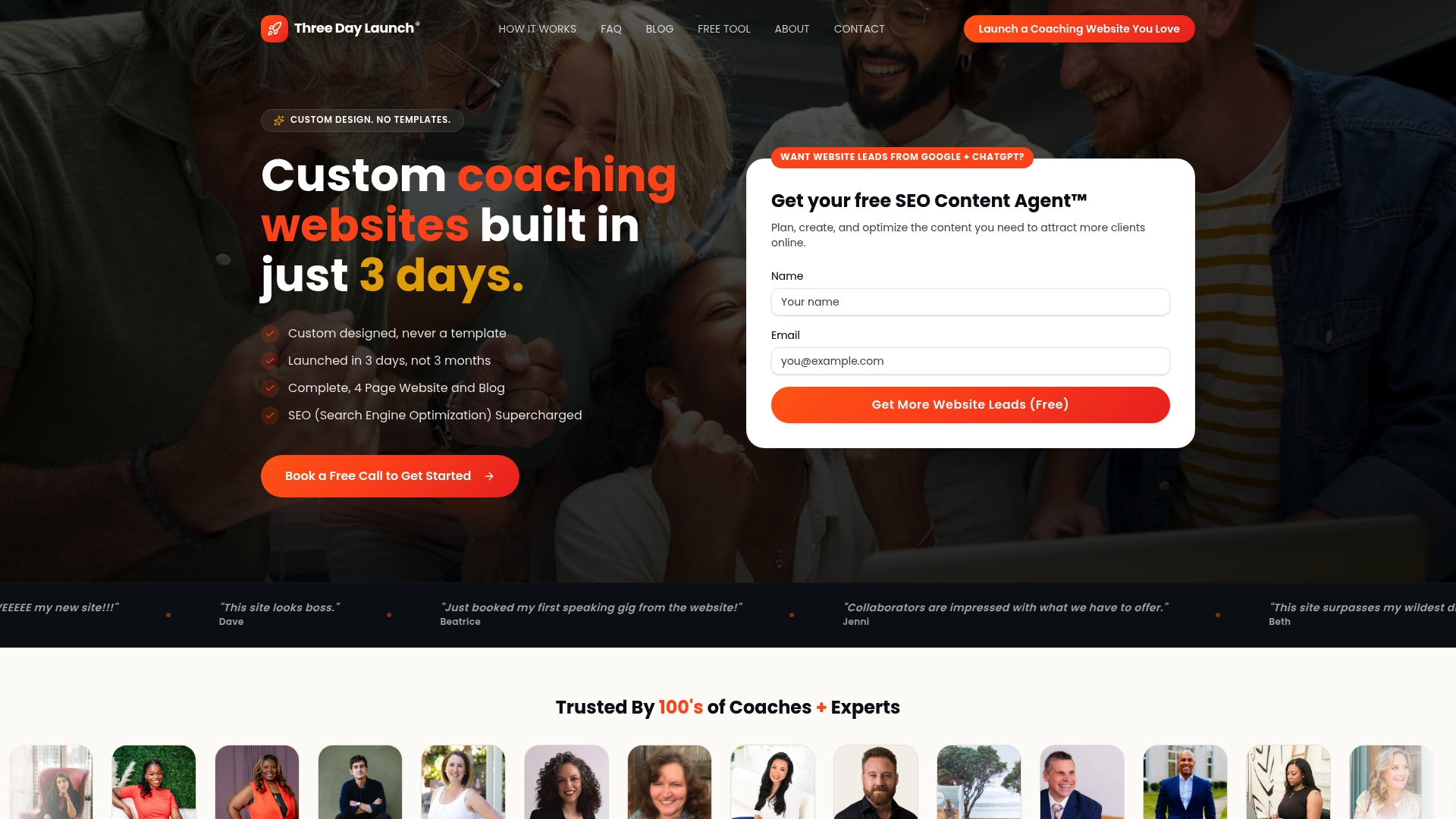
Three Day Launch builds fully custom, multi-page coaching websites in just three days. No templates, no generic layouts, just a site designed around your niche, your credentials, and your booking process. Coaches in life, finance, and health have reported real growth in organic traffic and client inquiries shortly after launch. If you are ready to stop losing clients to a weak online presence, check out custom coaching websites built specifically to convert. Your next client is already searching for you.
FAQ
What are the most important website elements for coaches?
The most important elements are a clear niche statement, visible credentials, specific client testimonials, a direct booking link, and transparent service pages. Together, these features build trust and reduce friction in the client decision process.
How do I attract coaching clients through my website?
Homepages that state your niche and outcome within 5 seconds keep visitors engaged and reduce bounce rates. Pair that with a direct booking CTA on every page to move visitors toward a discovery call.
Should I list pricing on my coaching website?
Yes. Listing clear prices qualifies leads immediately, attracting financially ready clients and saving your time on calls with prospects who are not ready to invest.
What booking tool should coaches use on their website?
Calendly and Acuity Scheduling are the two most widely used direct booking tools for coaches. Both eliminate back-and-forth scheduling and connect directly to your calendar for automated confirmations and reminders.
Where should I display my coaching credentials?
Display your credentials in your homepage hero section, your About page header, and your service pages. 73% of coaching clients expect to see recognized certifications prominently, so visibility above the fold is the standard to meet.