Why Coaches Need Websites: Your Client Growth Engine
A coaching website is your 24/7 client acquisition engine. Learn why coaches need websites to rank on Google, own their audience, and convert more discovery calls.
A coaching website is the single most powerful client acquisition and business management tool available to any coach, at any career stage. Without one, you are invisible to the clients actively searching for your expertise right now. Why coaches need websites goes beyond having a digital business card. Your site is your storefront, your intake coordinator, and your first handshake with every potential client, all running 24 hours a day without you lifting a finger. The coaches who grow fastest treat their websites as living systems, not static pages, and the results speak for themselves.
Why coaches need websites more than social media alone
Social media is great for visibility, but it is a rented space. Algorithms change overnight, accounts get restricted, and your carefully built audience can disappear without warning. A dedicated coaching website gives you full control over your brand, your message, and your client pipeline.

The biggest practical advantage is search engine optimization, or SEO. SEO for coaching sites focuses on keyword targeting, page structure, and building authority through consistent content. That means when someone in your city types "life coach for career transitions" into Google, your site can show up. Social media profiles almost never rank for those searches.
Here is where the numbers get interesting:
- Optimized landing pages generate 55% more leads than generic pages. That is not a small edge. That is the difference between a full client roster and an empty calendar.
- A website lets you place clear calls-to-action (CTAs) exactly where a visitor is most ready to act, something a social media bio link simply cannot replicate.
- You own the data. Email lists, booking records, and analytics from your own site belong to you, not to a platform.
The contrast is stark. On Instagram or LinkedIn, you are competing with every post in a feed. On your website, the visitor came specifically to learn about you. That intent is gold, and a well-built site converts it into booked calls.
Pro Tip: Run a simple Google search for your coaching niche plus your city. If your website does not appear on the first page, that is your biggest growth opportunity right now.
Why coaches need multiple web pages, not just one
A single homepage is not enough. The importance of multiple specialized pages on a coaching site comes down to one thing: each page serves a different stage of the client decision process.
Think of it like a conversation. A first-time visitor needs to understand who you are before they will trust you with their goals. Here is how each core page earns its place:
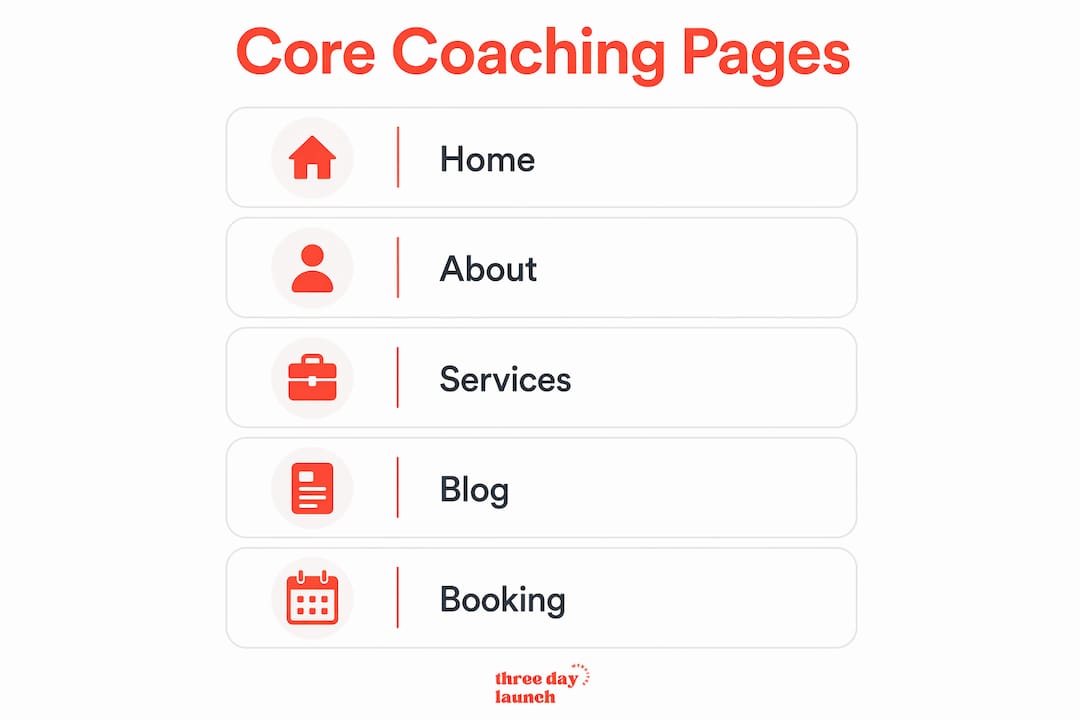
| Page | Primary Function | Client Journey Stage |
|---|---|---|
| Home | Capture attention, state your value clearly | Awareness |
| About | Build personal connection and credibility | Interest |
| Services | Detail offerings and pricing, drive decisions | Consideration |
| Blog | Demonstrate expertise, improve SEO rankings | Discovery and Trust |
| Booking | Remove friction, convert interest into action | Decision |
Dedicated service pages are especially powerful. When a health coach creates a separate page for "stress management coaching" versus "weight loss coaching," each page can target its own search keywords and speak directly to that specific client. Generic "here's what I do" pages dilute that focus and cost you leads.
The blog page deserves special attention. Active coaching blogs generate 67% more monthly leads than sites without one. That is because each blog post is a new indexed page, a new entry point for someone searching for answers you can provide.
Pro Tip: Put one CTA per page, and make it the same CTA throughout your site. Multiple competing CTAs create decision fatigue and cause visitors to leave without taking any action. Pick one next step, such as "Book a Free Call," and repeat it consistently.
What content strategy actually builds a coaching business
Content is how you build trust before a prospect ever speaks to you. The coaches who consistently attract high-quality clients are the ones who show their thinking, their process, and their results through the content on their site.
Here are the content types that convert best for coaching websites:
- Blog posts targeting specific problems your ideal client is Googling right now (e.g., "how to stop procrastinating at work" for a productivity coach)
- Client journey narratives that walk prospects through what working with you actually looks like, from first call to final session
- Testimonials and case studies that show real outcomes, not just nice words
- FAQ pages that address objections before a sales conversation even starts
Client journey frameworks build trust, set clear expectations, and separate you from every other coach with a vague "I help you reach your potential" headline. When a prospect can see the exact steps of your process, they feel safer saying yes.
The SEO payoff from consistent blogging compounds over time. One blog post might bring in three leads this month. Twelve posts might bring in forty leads six months from now. That is content marketing working as a long-term asset, not a one-time campaign.
Pro Tip: Your client journey content does not have to live only on your website. Repurpose it into an email sequence, a free guide, or even the outline for a future course or book. One framework, multiple revenue streams.
How integrated tools turn your website into an operating system
Most coaches treat their website as a static brochure. That is a costly mistake. Expert coaches describe their websites as operating systems that automate administrative tasks, freeing up their time for actual coaching.
Here is what that looks like in practice:
- Embedded booking tools like Calendly or Acuity Scheduling let clients book sessions directly from your site without a single email exchange.
- Online payment processing through Stripe or PayPal, embedded in the booking flow, means you get paid before the session, not after chasing invoices.
- Intake forms built into the site collect client information automatically, so you walk into every first session prepared.
- Email list integrations with tools like ConvertKit or Mailchimp capture leads who are not ready to book yet, keeping them in your pipeline.
Let's Launch Your Strategic Coaching Website
Your first step is to book a free call so we can get your questions answered.
Book A Free CallSuccessful coach websites embed booking, intake, and payment processing directly in the site flow. That continuity matters. Every time a prospect has to leave your site to complete a step, such as clicking to an external booking page or sending an email to ask about pricing, you lose a percentage of them. Friction kills conversions.
The operational benefits extend beyond client acquisition. When your website handles scheduling and payments automatically, you reclaim hours every week. A finance coach running a full client load could easily spend five or more hours per week on scheduling alone without automation. That time goes back into coaching, content creation, or simply not working on weekends.
Clear, client-focused messaging paired with a single strong CTA on every page is what ties the whole system together. The tools handle the logistics. The messaging handles the persuasion. Together, they create a site that works for you around the clock.
Key takeaways
A coaching website functions as both a client acquisition engine and an operational system, and coaches who treat it as anything less leave significant revenue on the table.
| Point | Details |
|---|---|
| Websites outperform social media | You own the traffic, the data, and the client relationship when leads come through your site. |
| Multiple pages drive more leads | Dedicated service and blog pages target specific searches and convert better than single-page sites. |
| Blogs compound your lead flow | Active coaching blogs generate 67% more monthly leads, and that advantage grows over time. |
| Integrated tools reduce admin work | Embedding booking, payment, and intake forms directly in your site removes friction and saves hours weekly. |
| One CTA per page wins | Single, consistent calls-to-action prevent decision fatigue and guide visitors toward booking a call. |
What i've learned building websites for coaches at every stage
Here at Three Day Launch, we have built websites for life coaches just starting out, finance coaches with established practices, and health coaches trying to scale past one-on-one sessions. The pattern we see most often is this: coaches underestimate what their website is supposed to do.
A surprising number of coaches come to us with a site that looks fine but does nothing. Nice colors, a professional headshot, a paragraph about their philosophy. Zero bookings from organic traffic. The problem is almost always the same: the site was built to impress, not to convert.
The coaches who see real results treat their website as a system with a job to do. Every page has a purpose. Every CTA points to one action. The blog is updated regularly. The booking tool is embedded, not linked out to a third-party page. When all of those pieces work together, the site stops being a cost and starts being a revenue source.
One thing I would push back on is the idea that you need to wait until your coaching practice is "established" before investing in a proper website. The coaches who build strong sites early are the ones who get established faster. Your website is not a reward for success. It is a tool for creating it.
— Three Day Launch
Get a professional coaching website launched in 3 days
You do not have to spend months waiting for a website that actually works for your coaching business. Three Day Launch builds fully functional, custom coaching websites in just three days, with multiple pages, embedded booking tools, and SEO-ready structure built in from day one.
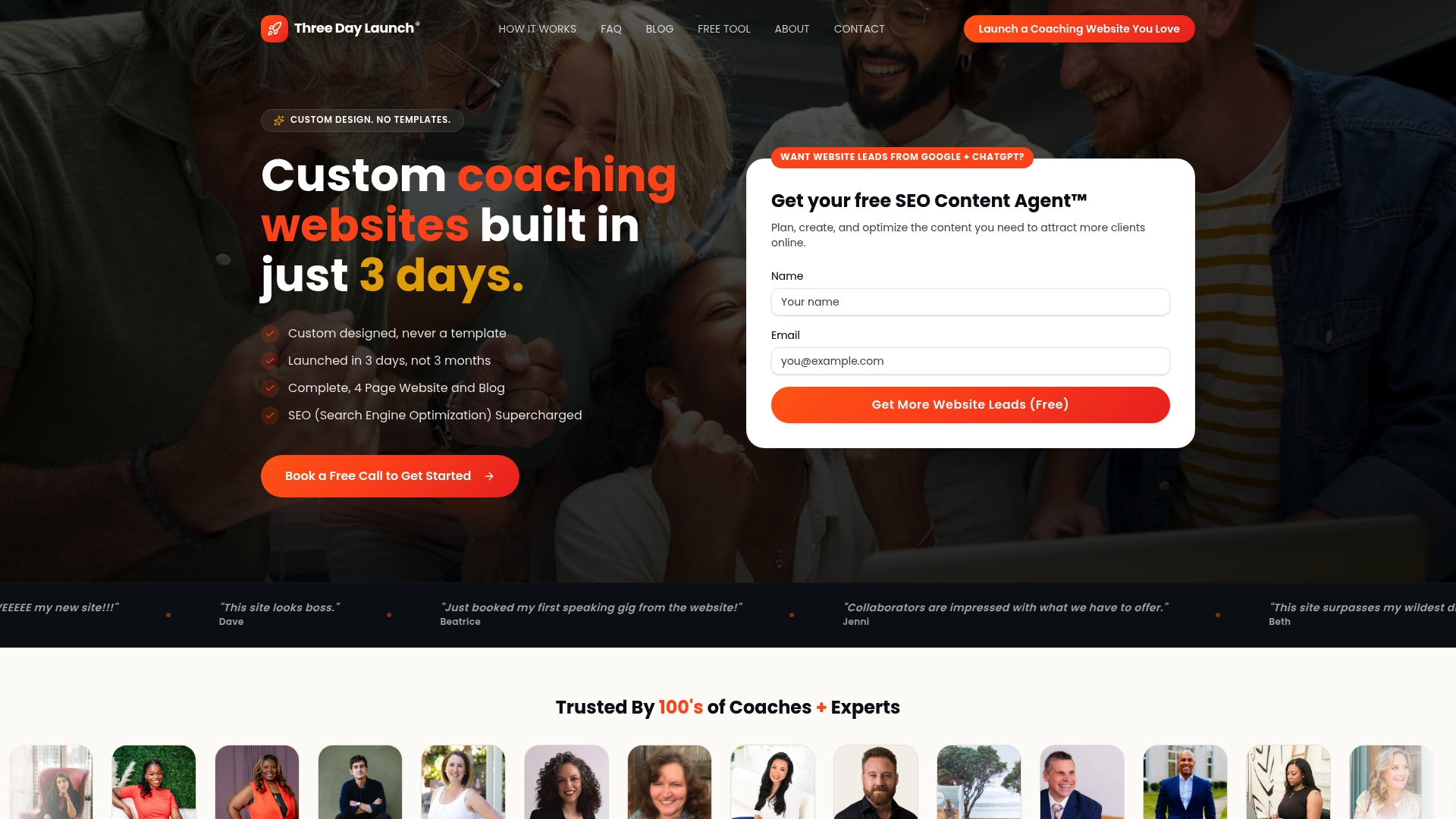
Coaches across life, health, and finance niches have used Three Day Launch to go from no online presence to a lead-generating site in a single week. No templates, no guesswork, and no months-long back-and-forth with a design agency. If you are ready to stop losing clients to coaches with better websites, explore how fast custom design can get your practice in front of the right people starting this week.
FAQ
Why do coaches need websites instead of just social media?
A coaching website gives you full ownership of your brand, your leads, and your client data. Social platforms can change their algorithms or restrict your account at any time, but your website is an asset you control completely.
How many pages should a coaching website have?
A coaching website should have at least five core pages: Home, About, Services, Blog, and Booking. Dedicated service pages generate 55% more leads than generic pages, so adding separate pages for each coaching offering pays off quickly.
What is the biggest mistake coaches make with their websites?
The most common mistake is treating the site as a static brochure rather than an operational system. Coaches who do not embed booking and payment tools directly into their site lose clients to friction at every step of the process.
How does a blog help a coaching website get more clients?
Active coaching blogs generate 67% more monthly leads than sites without one. Each post creates a new indexed page that can rank in search results, bringing in prospects who are actively looking for the answers you provide.
How long does it take to build a coaching website?
Traditional web design agencies can take two to four months. Services like Three Day Launch deliver a fully functional, multi-page coaching website in three days, which means you can start generating leads almost immediately.