How Website Architecture Affects Rankings: 2026 Guide
Website architecture shapes crawlability, internal link equity, and user experience. Learn how flat hierarchy, topical clusters, and clean URLs boost SEO rankings in 2026.

How Website Architecture Affects Rankings: 2026 Guide
Website architecture is the structural design of your site, including its page hierarchy, URL organization, and internal linking, and it directly determines how well search engines can crawl, index, and rank your content. Most website owners obsess over blog posts and backlinks while ignoring the foundation underneath. That foundation is how website architecture affects rankings in ways that no amount of new content can fix. John Mueller of Google has stated that logical site structure signals topical authority beyond keyword matching alone. Get the structure wrong, and Google simply cannot understand what your site is about.
How does website architecture affect rankings and crawlability?
Website architecture controls how easily Google's crawlers move through your site. Think of it like a road map. A clear map gets you everywhere fast. A confusing one leaves you lost in a dead end.
Google allocates crawl budget based on a site's size, speed, and authority. Deep, fragmented structures waste that budget, meaning important pages get crawled less often or not at all. When pages are buried five or more clicks from your homepage, they receive diluted PageRank and reduced crawl frequency. That directly limits their ranking potential.

The industry standard most SEOs follow is the "3-click rule," meaning any page should be reachable within three clicks from the homepage. The real metric Google values is minimizing crawl depth for key pages to maximize crawl frequency and authority flow. A flat architecture, where most pages sit two to three levels deep, keeps your most valuable content visible and well-indexed.
Here is what a poor versus flat hierarchy looks like in practice:
- Deep structure (avoid): Homepage > Category > Subcategory > Sub-subcategory > Article (5 clicks)
- Flat structure (target): Homepage > Category > Article (2 clicks)
- Result of flattening: One B2B client saw indexed pages increase by 20% and priority keyword rankings improve by 15% within three months after restructuring their folder depth.
Pro Tip: Run a crawl audit using a tool like Screaming Frog to map your current click depth. Any page more than three clicks from the homepage is a candidate for restructuring.
How do internal links distribute authority across your site?
Internal links are the wiring of your site. They tell Google which pages matter most and how topics relate to each other. Done right, they multiply the ranking power of every page you publish.
Internal links pass link equity through your site, and pages closer to the homepage naturally receive more of it. That authority influences ranking potential directly. The placement of those links matters just as much as their existence.
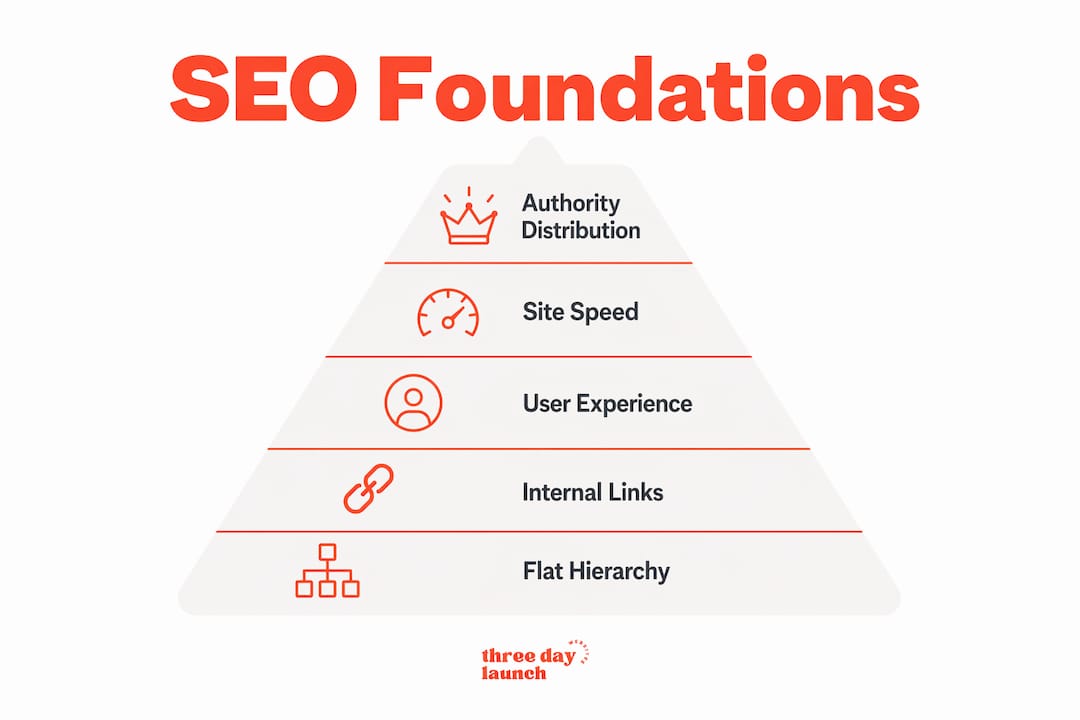
Google views contextual internal links in body content as stronger ranking signals than navigation or footer links. A link placed inside a relevant paragraph, with descriptive anchor text, signals topical relevance. A link buried in a footer carries far less weight.
The most effective internal linking strategy follows a hub-and-spoke model, also called topical clustering. Here is how to build one:
- Create a pillar page. Write one comprehensive page covering a broad topic, such as "coaching business growth."
- Build cluster pages. Write several detailed pages on subtopics, like "email marketing for coaches" or "pricing your coaching packages."
- Link cluster pages to the pillar. Each cluster page links back to the pillar, and the pillar links out to each cluster.
- Add contextual cross-links. Link cluster pages to each other where topics overlap naturally.
- Fix orphan pages. Any page with no internal links pointing to it is invisible to crawlers. Fixing orphan pages often produces quick ranking gains without writing a single new word.
A well-linked topical cluster signals deep expertise to Google's algorithms, which rewards sites that demonstrate authority across a subject area rather than isolated keyword matches.
Pro Tip: Export your internal link data from Google Search Console and look for pages with zero or one inbound internal link. Those are your orphan pages. Add two to three contextual links to each from related content.
Does site architecture influence user experience and SEO metrics?
Architecture shapes more than crawl paths. It shapes how real people feel when they land on your site. And how people behave on your site sends signals directly to Google.
A clean, well-organized site keeps visitors moving through your content. Confusing navigation causes people to leave fast, which raises your bounce rate and lowers your average session duration. Both metrics influence how Google evaluates your page quality. The impact of website design on user trust is measurable and significant, particularly for newer or lesser-known brands.
Site speed is also an architectural issue, not just a hosting issue. Structural complexity, bloated URL paths, and excessive redirects all slow your site down. Improving load speed by one second can increase conversion rates by 27%, while a one-second delay reduces conversions by up to 20%. Those numbers reflect real revenue, not abstract metrics.
The table below shows how specific architectural choices connect to measurable SEO and UX outcomes:
| Architectural factor | SEO and UX impact |
|---|---|
| Flat page hierarchy | Higher crawl frequency, stronger PageRank flow to key pages |
| Clean, semantic URLs | Better crawlability and higher user trust |
| Contextual internal links | Stronger topical authority signals to Google |
| Fast load speed | Higher conversions and lower bounce rates |
| Professional visual design | Increased trust and longer session duration |
Professional site aesthetics act as a trust signal that moderates user behavior and conversion intent, especially for brands that visitors do not yet recognize. Your site's visual credibility is part of its architecture in the broadest sense. A site that looks trustworthy keeps people engaged, and engaged users rank you higher.
What are the best practices for optimizing site architecture?
Let's Launch Your Strategic Coaching Website
Your first step is to book a free call so we can get your questions answered.
Book A Free CallFixing your site's architecture does not require rebuilding from scratch. Most improvements come from targeted audits and deliberate restructuring. Here is where to start:
- Audit your crawl depth. Use a crawler to identify pages beyond three clicks from your homepage. Prioritize moving your highest-traffic and highest-value pages closer to the surface.
- Map your internal links. Identify which pages receive the most internal links and which receive none. Redistribute link equity intentionally toward pages you want to rank.
- Fix orphan pages immediately. Orphan page fixes often yield quick ranking improvements without new content, because they improve crawl coverage and link equity distribution across your site.
- Clean up your URL structure. A semantic URL structure with keyword-rich folder names improves both crawl clarity and user navigation. Avoid dynamic parameters and random strings in URLs.
- Build topical hubs. Group related content into clusters with a clear pillar page at the center. This structure signals expertise to Google and makes your site easier for visitors to navigate.
- Eliminate redirect chains. Every redirect adds latency and dilutes link equity. Audit your redirects and point links directly to the final destination URL.
- Use breadcrumb navigation. Breadcrumbs reinforce your hierarchy visually for users and structurally for crawlers. They also appear in Google search results, improving click-through rates.
The centralized link organization principle applies here too. Sites that organize their content around clear topical hubs, rather than scattered standalone pages, build authority faster and hold rankings longer. Architectural maintenance is not a one-time project. Revisit your structure every six months as your content library grows.
Key Takeaways
Website architecture is the single most underleveraged SEO factor for most website owners, and fixing it produces measurable ranking gains faster than publishing new content alone.
| Point | Details |
|---|---|
| Flat hierarchy wins | Keep key pages within three clicks of the homepage to maximize crawl frequency and PageRank flow. |
| Internal links carry authority | Contextual body links pass stronger ranking signals than navigation or footer links. |
| Orphan pages hurt rankings | Pages with no internal links are invisible to crawlers; fixing them improves rankings without new content. |
| Speed is an architectural issue | A one-second load improvement can increase conversions by 27%, making structural simplicity a revenue decision. |
| Topical clusters build authority | Grouping related pages into hub-and-spoke clusters signals deep expertise that Google rewards. |
Why architecture is the SEO work nobody wants to do (but everyone needs)
Honestly, architecture is the unglamorous side of SEO. Nobody gets excited about auditing click depth or mapping internal links. Everyone wants to write more content or chase backlinks. I get it. But here is what I have seen working with coaches and small business owners: the sites that rank consistently are almost never the ones with the most content. They are the ones where Google can actually find and understand every page.
The most common mistake I see is a site that has grown organically over years, with pages added whenever someone had an idea, and no one ever stepped back to look at the whole structure. The result is a sprawling mess where the best content is buried five clicks deep and orphan pages are scattered everywhere. Google's crawlers give up before they even find the good stuff.
The other thing worth saying: architecture and user experience are the same problem viewed from two angles. When you build a site that is easy for Google to crawl, you almost always build a site that is easier for real people to use. The coaching website features that convert clients are the same ones that help search engines understand your authority. That alignment is not a coincidence. It is the whole point.
Start with an audit. Fix your orphan pages. Flatten your hierarchy. Then build your topical clusters. Do that before you write another blog post, and you will see results that content alone cannot deliver.
Your site's structure is your SEO foundation
If you are a coach ready to build a site that Google can actually crawl and rank, Three Day Launch builds custom websites in three days with SEO-friendly architecture baked in from the start. No templates, no guesswork, no months of waiting.

Every Three Day Launch site is built with flat hierarchy, clean URL structure, and internal linking patterns that support long-term rankings. Coaches in life, finance, and health have seen real organic traffic growth shortly after launch, because the foundation was right from day one. If your current site is a structural mess, or you are starting fresh, this is the fastest path to a site that works for both Google and your future clients.
FAQ
How does website architecture affect SEO rankings?
Website architecture affects SEO by controlling how efficiently Google crawls and indexes your pages. A flat, well-linked structure ensures key pages receive strong PageRank flow and frequent crawl attention.
What is crawl budget and why does it matter?
Crawl budget is the number of pages Google will crawl on your site within a given period. Deep or fragmented site structures waste crawl budget, leaving important pages unindexed and unranked.
How many clicks deep should my pages be?
Key pages should be reachable within three clicks from your homepage. Pages buried five or more clicks deep receive diluted PageRank and are crawled less frequently, which limits their ranking potential.
What are orphan pages and how do they hurt rankings?
Orphan pages are pages with no internal links pointing to them. Crawlers discover content by following links, so orphan pages are effectively invisible to search engines and receive no link equity.
Does site speed count as part of website architecture?
Yes. Structural complexity, bloated URL paths, and excessive redirects all slow your site down. Improving load speed by one second can increase conversions by 27%, making speed a direct architectural and revenue concern.