How Fast Website Launch Works: 2026 Guide
How fast website launch works in 2026: AI sites in under 2 minutes, custom workflows in 90 minutes, DNS in 5. What actually controls speed.
How fast website launch works is the measure of total time from initial concept to a live, accessible URL, typically ranging from under 2 minutes for simple AI-generated sites to around 90 minutes for custom solo founder workflows. The industry term for this process is rapid deployment, and it covers everything from code generation and design to DNS propagation and going live. If you're a coach, entrepreneur, or solopreneur who has been putting off your website because you assumed it would take weeks, this guide is going to change your thinking fast. The technology available in 2026 makes a professional online presence achievable in a single afternoon.
How fast website launch works: key factors that control speed
The speed of a website launch depends on two very different clocks. The first is the machine clock. The second is the human clock.
The machine clock is fast. Actual compute time for generating and deploying a website is often under 10 seconds. That means the server side of your launch is essentially instant. What slows everything down is the human side: filling out forms, making decisions about copy, choosing colors, and figuring out what your offer actually says.
Here are the most common factors that control your total launch time:
- Content readiness. If you don't know your headline, your offer, or your call to action before you start, you will stall. This is the single biggest time sink for most coaches and solopreneurs.
- Platform choice. AI site builders like the RationalGo App Builder or GeminiLaunch eliminate Git setup, server configuration, and manual code deployment. Traditional platforms require all three.
- DNS propagation. Connecting a custom domain used to mean waiting 24–48 hours. With modern providers like Cloudflare, propagation completes in under 5 minutes in most cases.
- Deployment caching. Warm redeployments with cached dependencies finish in 28–47 seconds. Cold builds without caching take 1–2 minutes. The difference matters when you're iterating fast.
- Infrastructure errors. DNS misconfigurations, domain permission issues, and database ownership conflicts are the biggest hidden time sinks in most launches, not the code itself.
Pro Tip: Write your headline, your one-sentence offer, and your call to action before you open any website builder. That single act removes the most common cause of launch delays.
Ai-generated sites vs. custom workflows: which is faster?
These two approaches are not competing for the same job. They solve different problems at different speeds.

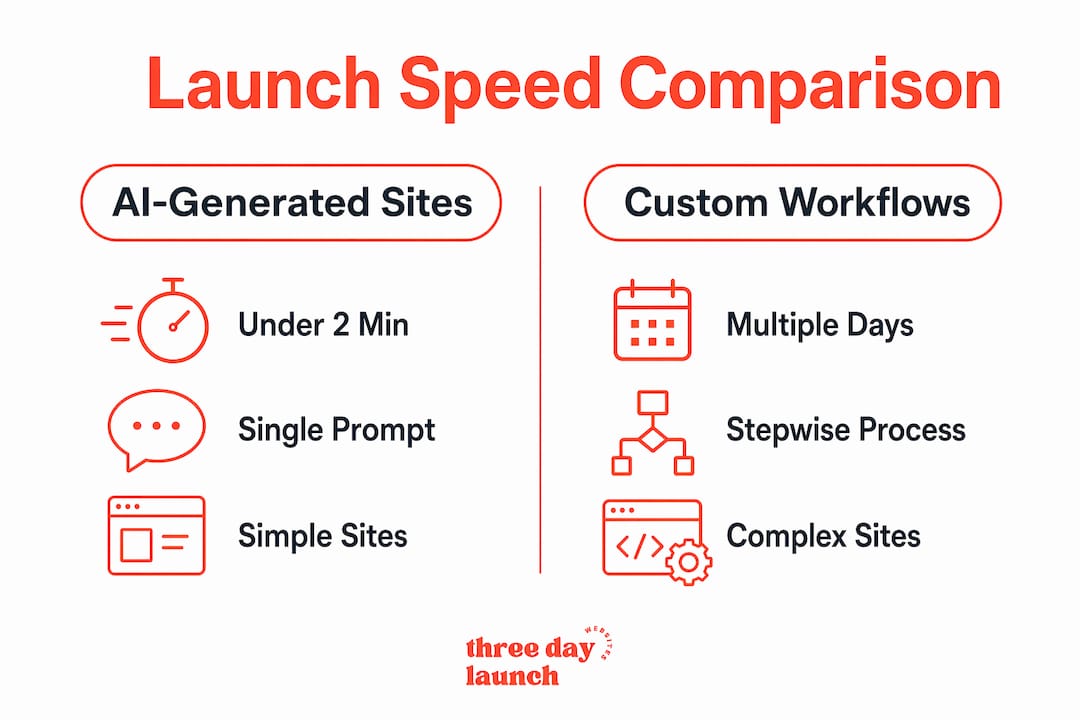
An AI site builder creates a simple, functional site from a single text prompt in under 2 minutes. For complex sites with user authentication or databases, that time increases to 5–15 minutes. That speed is real, but the tradeoff is customization. You get what the AI interprets from your prompt, not a site built around your brand voice, your client journey, or your specific conversion goals.
A custom solo founder workflow using AI tools like Claude or ChatGPT for copy and code generation takes longer but produces a more intentional result. Research from 500k.io documents an average launch time of 87–90 minutes, with a fastest documented run of 56 minutes. That workflow breaks down into defined stages.
| Stage | Task | Time |
|---|---|---|
| Strategy | Define ICP, offer, and positioning | 8 min |
| Copy | Write headlines, body, and CTA | 12 min |
| Code generation | Build page structure with AI | 18 min |
| Design | Apply visual styling and layout | 20 min |
| SEO and schema | Add metadata and structured data | 12 min |
| Deployment | Push live and connect domain | 8 min |
The table above shows something important. Design takes the most time in a custom workflow, not code. That's because design decisions require human judgment. Code generation is largely automated.
Pro Tip: Choose the AI-prompt approach if you need a placeholder or test page live today. Choose the structured workflow if you need a site that actually converts visitors into clients.
How modern deployment tech speeds up your launch
The backend of a website launch has gotten dramatically faster over the last few years. Understanding what happens under the hood helps you make smarter choices about your tools.
Here's how the deployment process works in a modern rapid launch:
- Code generation completes. Your AI tool or builder writes and compiles the site files. This takes seconds, not minutes.
- Build scripts run. Optimized deployment scripts like those used by Deploynix complete deployment in under 2 minutes with zero downtime. The script runs all build steps before swapping to the new release directory, so visitors never see a half-finished page.
- Caching kicks in. Warm redeployments with cached dependencies finish in as little as 28–47 seconds. That speed is only possible because the system skips reinstalling packages it already has.
- DNS propagates. With Cloudflare or similar providers, your custom domain points to your new site in under 5 minutes. The old myth of 24–48 hour waits applies to outdated infrastructure, not 2026 tools.
- Verification completes. Tools like whatsmydns.net let you track propagation progress in real time so you know the moment your site is live globally.
The key insight here is that deployment latency is a product design problem, not a compute problem. Platforms that strip unnecessary steps deliver near-instant results. Platforms that require manual Git pushes, server SSH access, or FTP uploads add minutes of friction that have nothing to do with your actual site.
Pro Tip: Validate your site on a free subdomain first. Once everything looks right, connect your custom domain. This separates the build step from the DNS step and cuts troubleshooting time significantly.
Practical strategies to speed up your website launch
Knowing the theory is one thing. Getting your site live fast is another. Here's what actually works for coaches and solopreneurs who need results, not a tech degree.
Lock down your offer before you touch any tool
Pre-planning your offer and ideal customer profile in about 8 minutes upfront saves roughly 40 minutes downstream. That's not a small gain. It means the difference between a 90-minute launch and a 3-hour frustration session. Write down who you help, what you help them do, and what you want them to do on your site. Do that before you open a single builder.
Use platforms that remove infrastructure decisions
Platforms that handle hosting, deployment, and domain connection in one place remove the biggest non-creative time sinks. You should not be configuring servers or managing DNS records manually in 2026. If your platform requires that, switch platforms. Moving your coaching business online quickly is entirely possible when you pick tools built for speed.
Avoid these common launch killers
Let's Launch Your Strategic Coaching Website
Your first step is to book a free call so we can get your questions answered.
Book A Free Call- Undecided copy. If you can't write your headline in 60 seconds, your offer needs more clarity, not more time on the builder.
- Perfectionism on design. Launch with good enough. You can update the colors after your first client books.
- Manual DNS management. Use a registrar with a simple dashboard and follow the platform's exact instructions. One wrong record wastes an hour.
- Skipping mobile review. Check your site on a phone before you call it live. Most of your visitors will arrive on mobile.
- No clear call to action. Every page needs one next step. "Book a call," "Download the guide," or "Join the waitlist" all work. Nothing is not an option.
Pro Tip: Schedule your deployment during off-peak hours, typically early morning. DNS propagation and server response times are measurably faster when global traffic is lower.
Key takeaways
A fast website launch depends more on human preparation than on technology speed, since modern deployment tools already operate in seconds.
| Point | Details |
|---|---|
| AI tools launch in minutes | Simple AI-generated sites go live in under 2 minutes; complex builds take 5–15 minutes. |
| Custom workflows average 90 minutes | A structured AI-first workflow with defined stages produces a conversion-ready site in under 90 minutes. |
| DNS is no longer a bottleneck | Modern providers like Cloudflare propagate domain changes in under 5 minutes, not 24–48 hours. |
| Human decisions cause most delays | Content indecision and infrastructure errors add more time than code generation ever will. |
| Pre-planning saves 40 minutes | Defining your offer and ideal customer upfront compresses the entire downstream build process. |
Why launch speed is a business decision, not just a tech one
Here's what I've learned from working with coaches and solopreneurs on fast website launches: the technology is rarely the problem. The hesitation is.
I've watched people spend three weeks "getting ready" to launch a site that took 90 minutes to build. They were waiting until their copy was perfect, their photos were professional, and their offer felt airtight. What they were really doing was avoiding the feedback that comes from being visible. A fast launch forces you to get real input from real people, and that input is worth more than any amount of internal refinement.
Faster deployments enable smaller, safer, and more frequent releases. That's true for software teams, and it's equally true for coaches. When you know you can update your site in minutes, you stop treating every word like it's carved in stone. You start treating your website like a living tool that grows with your business.
The coaches I've seen get the best results are not the ones who spent the most time on their site before launch. They're the ones who launched fast, got feedback, and updated within the first two weeks. Speed creates momentum. Momentum creates clients.
My honest advice: pick a workflow that matches your current skill level, define your offer before you touch any tool, and get something live this week. A good site that exists beats a perfect site that doesn't.
— Three Day Launch
Get your custom site live in three days
You now know exactly how a fast website launch works. The next question is whether you want to build it yourself or have it done for you, professionally, in three days flat.

Three Day Launch builds fully custom, multi-page websites for coaches, entrepreneurs, and solopreneurs who need a real online presence without the months-long wait. No templates. No cookie-cutter layouts. Just a site designed around your offer, your brand, and your clients. Coaches in life, finance, and health have used Three Day Launch to drive organic traffic and convert leads from day one. If you're ready to stop waiting and start showing up online, explore custom website design built for your business and launched in three days.
FAQ
How fast can a website go live in 2026?
A simple AI-generated site can go live in under 2 minutes. A custom landing page built with an AI-first workflow typically takes 87–90 minutes from concept to live URL.
What slows down a website launch the most?
Human decision-making and content indecision cause more delays than any technical factor. Infrastructure issues like DNS errors and domain permissions are the second biggest time sink.
How long does DNS propagation actually take?
With modern providers like Cloudflare, DNS propagation completes in under 5 minutes. The traditional 24–48 hour estimate applies to outdated registrars and infrastructure.
Do i need technical skills to launch a website quickly?
No. Platforms built for rapid deployment handle hosting, code generation, and domain connection without requiring Git, server access, or coding knowledge. The right platform choice removes nearly all technical barriers.
What is the fastest documented custom website launch?
A solo founder using an AI-first workflow documented a fastest launch time of 56 minutes from idea to live landing page, with an average of 87–90 minutes across multiple runs.