What Is a Business Online Presence? A Clear Guide
A business online presence is every digital touchpoint where customers find and evaluate you: website, Google Business Profile, social media, reviews, and directory listings.
A business online presence is the complete collection of digital touchpoints customers encounter when they search for your company, including your website, social media profiles, Google Business Profile, online reviews, and directory listings. Think of it as your digital footprint: every place a potential client can find, evaluate, or form an opinion about you before ever picking up the phone. 99% of consumers use the internet to discover local businesses. That number alone tells you everything about why this matters.
What is a business online presence made of?
Your online presence has two distinct layers: controlled assets and reputation signals. Controlled assets are things you own and manage directly. Reputation signals are what others say about you, and they exist whether you pay attention to them or not.
Here is a breakdown of the core components:
| Component | Control Level | Strength | Limitation |
|---|---|---|---|
| Business website | Full | Brand narrative, SEO, data ownership | Requires upkeep and investment |
| Google Business Profile | High | Local search visibility, reviews | Google can change rules |
| Social media profiles | Medium | Reach, engagement, community | Algorithm dependency |
| Online reviews | Low | Trust signals, conversion impact | Cannot delete negative ones |
| Directory listings | Medium | Citation consistency, local SEO | Outdated info spreads fast |
Your website is your digital headquarters. It is the one place where you control every word, image, and call to action. Google Business Profile drives local discovery and shows up prominently in map searches. Social media profiles build community but come with a catch: you are building on rented land. Reviews and third-party mentions are uncontrolled reputation signals that shape brand perception regardless of your activity level.

Pro Tip: Claim every directory listing you can find, even the ones you did not create. Inconsistent name, address, and phone number (NAP) data across directories confuses search engines and erodes local rankings.
Why does a strong online presence matter for your business?
The short answer: customers decide whether to trust you before they ever contact you. Potential customers form an opinion within seconds of searching your name. A weak or outdated presence acts as a trust killer and costs you revenue directly.
Here is what the data shows:
- 80% of U.S. consumers search for local businesses online every week.
- 76% of consumers research brick-and-mortar stores online before visiting in person.
- Responding to reviews increases the likelihood of being chosen by 41%.
That last stat is worth sitting with. You do not need a perfect five-star rating. You need to show up, respond, and engage. That alone moves the needle by 41%.
The importance of online presence goes beyond just being "findable." Your digital footprint communicates credibility. A business with a polished website, active social profiles, and recent positive reviews signals to customers that it is legitimate, current, and worth their time. A business with nothing, or worse, outdated information, signals the opposite.
Even if you run a fully offline business, like a local gym or a brick-and-mortar boutique, your customers are still researching you online first. The benefits of online visibility are not optional for modern businesses. They are the baseline.
Website vs. social media: which one actually builds your presence?
Social media is not a substitute for a professional website. Full stop. A website gives you full control over your brand narrative and user experience. Social platforms do not.
Here is the core problem with relying solely on social media:
- Algorithm changes can cut your organic reach overnight with zero warning.
- You do not own your follower list. If the platform shuts down or bans your account, that audience disappears.
- Social profiles do not give you the same SEO authority as a well-built website.
- You cannot fully customize the experience, the design, or the conversion path.
Your social profiles should drive traffic back to your website, not replace it. Think of Instagram or LinkedIn as the billboard and your website as the store. The billboard gets attention. The store closes the deal.
Web design directly affects credibility, and a poorly designed site can undermine trust just as fast as having no site at all. What is online branding if not the sum of every impression a customer gets? Your website is where that impression is most fully formed.
Pro Tip: Treat your website as a living asset, not a static brochure. Update it with fresh content, new testimonials, and current offers at least once a quarter. A stale website signals a stale business.
How to build your online presence step by step
Building a strong digital footprint does not require doing everything at once. Start with the foundation and build from there.
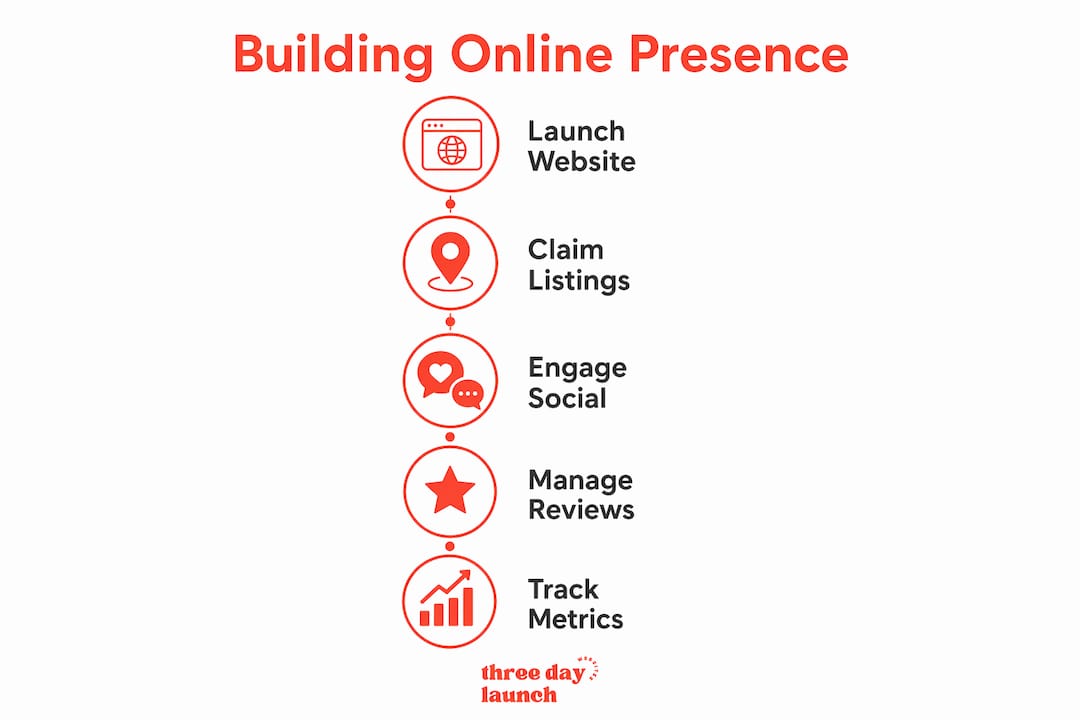
- Create a professional website. This is your most controlled and most valuable digital asset. It needs to load fast, look credible, and clearly explain what you do and who you serve.
- Claim your Google Business Profile. Fill it out completely, add photos, and keep your hours current. This is often the first thing customers see in search results.
- Build consistent social media profiles. Pick the platforms where your customers actually spend time. Mastering 1–2 core platforms delivers better results than spreading yourself thin across six.
- Monitor and respond to reviews. Set up Google Alerts and check your review platforms weekly. Responding to both positive and negative reviews builds trust and boosts conversion.
- Maintain NAP consistency. Your business name, address, and phone number must match exactly across every directory, profile, and listing. Inconsistency hurts local SEO.
- Align your brand visuals and tone. Consistency across logo, tone, and contact information is the primary driver of digital authority. Every touchpoint should feel like the same business.
| Action | Impact | Resource needed |
|---|---|---|
| Launch a professional website | High: credibility, SEO, conversions | Design investment or service |
| Claim Google Business Profile | High: local visibility | 30 minutes, free |
| Build 1–2 social profiles | Medium: reach and engagement | Ongoing time commitment |
| Respond to reviews | High: trust and conversion lift | 15 minutes per week |
| Audit directory listings | Medium: local SEO consistency | Monthly check |
Aligning your website design with your personal brand is not just an aesthetic choice. It is a trust signal. Customers notice when your Instagram looks nothing like your website.
How do you measure the success of your online presence?
You cannot improve what you do not track. Measuring your digital footprint means looking at both visibility and engagement across multiple channels.
Let's Launch Your Strategic Coaching Website
Your first step is to book a free call so we can get your questions answered.
Book A Free CallKey metrics to monitor:
- Website traffic and behavior: Use Google Analytics to track how many visitors you get, where they come from, and what pages they visit. A drop in organic traffic often signals an SEO or content issue.
- Search rankings: Track where your website appears for your core search terms. Tools like Google Search Console show which queries drive clicks.
- Google Business Insights: This free dashboard shows how many people found your profile, called your number, or requested directions. It is one of the clearest signals of local visibility.
- Review sentiment and volume: Track your average star rating and the frequency of new reviews. Both affect how customers perceive you before they visit.
- Social engagement: Monitor reach, comments, and profile visits. Engagement rate matters more than follower count.
Set a monthly benchmark review. Pick five metrics and check them on the same day each month. Consistency in measurement leads to consistency in growth.
Key Takeaways
A business online presence is built on controlled assets like your website and Google Business Profile, supported by reputation signals like reviews and third-party mentions, and held together by consistent branding across every digital touchpoint.
| Point | Details |
|---|---|
| Website is your foundation | Your website is the only digital asset you fully own and control. |
| Reputation signals are always active | Reviews and third-party mentions shape perception whether you manage them or not. |
| Social media supplements, not replaces | Use social profiles to drive traffic to your website, not as a standalone presence. |
| Consistency builds authority | Matching visuals, tone, and contact info across all platforms drives brand recognition. |
| Focus beats spread | Mastering 1–2 platforms outperforms a thin presence across many channels. |
What I have learned about online presence after working with coaches
Here is something I see constantly: coaches and entrepreneurs spend weeks agonizing over their Instagram aesthetic while their website looks like it was built in 2014. The struggle is real, and I get it. Social media feels immediate. It feels alive. Your website feels like homework.
But here is the truth. Your website is the only piece of your online presence that you fully own. Social platforms can change their algorithm, suspend your account, or disappear entirely. Your website cannot be taken from you. That is not a small thing.
The other mistake I see is treating online presence as a one-time project. You build the site, claim the Google profile, and then walk away. Six months later, your hours are wrong, your reviews have gone unanswered, and your website still has a 2022 copyright in the footer. That kind of neglect is visible to customers, and it costs you.
What actually works is treating your digital footprint like a living part of your business. Update it. Respond to it. Audit it quarterly. The coaches who do this consistently are the ones who show up on the first page of Google and convert visitors into paying clients. A DIY website often creates more problems than it solves, especially when it comes to credibility and first impressions.
Build it right, keep it current, and your online presence works for you around the clock.
— Three Day Launch
Ready to build a presence that actually converts?
Your online presence starts with your website. If yours is outdated, templated, or just not converting visitors into clients, that is a fixable problem. Three Day Launch builds fully custom, multi-page websites for coaches in just three days, no templates, no months-long timelines, and no guesswork.

Coaches in life, finance, and health have used Three Day Launch to launch sites that generate organic leads from day one. If you are ready to stop losing clients to a weak digital first impression, get your custom website built fast and built right.
FAQ
What is a business online presence?
A business online presence is the total collection of digital touchpoints where customers can find and evaluate your company, including your website, social profiles, Google Business Profile, reviews, and directory listings.
Why is online presence important for small businesses?
76% of consumers research businesses online before visiting in person. Without a strong presence, you lose customers before they ever contact you.
Can social media replace a professional website?
No. Social media profiles cannot replace a website because you do not own your audience or control the platform. Your website is your only fully owned digital asset.
How many social media platforms should a business use?
Focus on 1–2 platforms where your customers are most active. Depth on fewer platforms produces stronger results than a thin presence spread across many channels.
How do online reviews affect business credibility?
Responding to customer reviews increases conversion likelihood by 41%. Active review management is one of the highest-return reputation activities a business can do.