Why DIY Websites Hurt Coach Brands and Cost Clients
DIY coach websites quietly erode credibility, kill conversions, and cap your pricing. Here is why and what to build instead.
DIY websites hurt coach brands by creating an amateurish first impression that erodes credibility before a single word is read. Your website is your storefront and your handshake, and 75% of potential clients judge a company's credibility based solely on website design, often within milliseconds of page load. That means a generic Wix or Squarespace template is not just a visual choice. It is a business decision with real consequences for your client pipeline, your pricing power, and your long-term brand authority.
Why DIY websites hurt coach brands through design limitations
The core problem with DIY website builders is not that they look bad. It is that they look the same. Platforms like Wix, Squarespace, and Weebly offer hundreds of templates, but those templates are built for everyone, which means they are built for no one in particular. When a life coach, a finance coach, and a health coach all use the same Squarespace theme with different colors, they send the same signal: generic.
Here is what that generic design actually costs you:
- No visual differentiation. Your brand colors, fonts, and layout are constrained by what the template allows. You cannot fully own your visual identity when you are working inside someone else's framework.
- Limited layout control. Want a specific section order, a custom hero image treatment, or a unique testimonial layout? Most DIY builders make these changes difficult or impossible without workarounds that break on mobile.
- Stock photo dependency. DIY sites push users toward stock imagery because custom photography integration is clunky. Stock photos signal inauthenticity, and clients notice.
- Template fatigue. Prospective clients browse multiple coach websites before making a decision. When yours looks like three others they just visited, you have already lost the differentiation battle.
DIY templates constrain coaches' uniqueness by forcing generic formats that do not grow with business models. That is not a minor inconvenience. It is a structural ceiling on how your brand can evolve.
Pro Tip: Before you pick any template or builder, write down three visual qualities you want clients to feel when they land on your site. If the platform cannot deliver all three without major workarounds, it is the wrong platform for your brand.
How poor user experience kills client acquisition
Design is what people see. User experience (UX) is what they feel. And on DIY sites, the UX problems are often invisible to the coach but immediately felt by the visitor.

Load speed is the most damaging technical issue. A coaching website that loads slower than 3 seconds risks losing visitors to competitors' faster sites. DIY builders load extra code, unused plugins, and bloated themes that slow everything down. That three-second window is not a guideline. It is the threshold between a visitor who stays and one who leaves forever.
Mobile responsiveness is the second major failure point. Over 60% of web traffic comes from mobile devices, making mobile responsiveness critical for coaching websites. Many DIY templates claim to be mobile-friendly but deliver a compressed, awkward version of the desktop site. Buttons are too small, text runs off the screen, and booking forms become nearly impossible to complete on a phone.
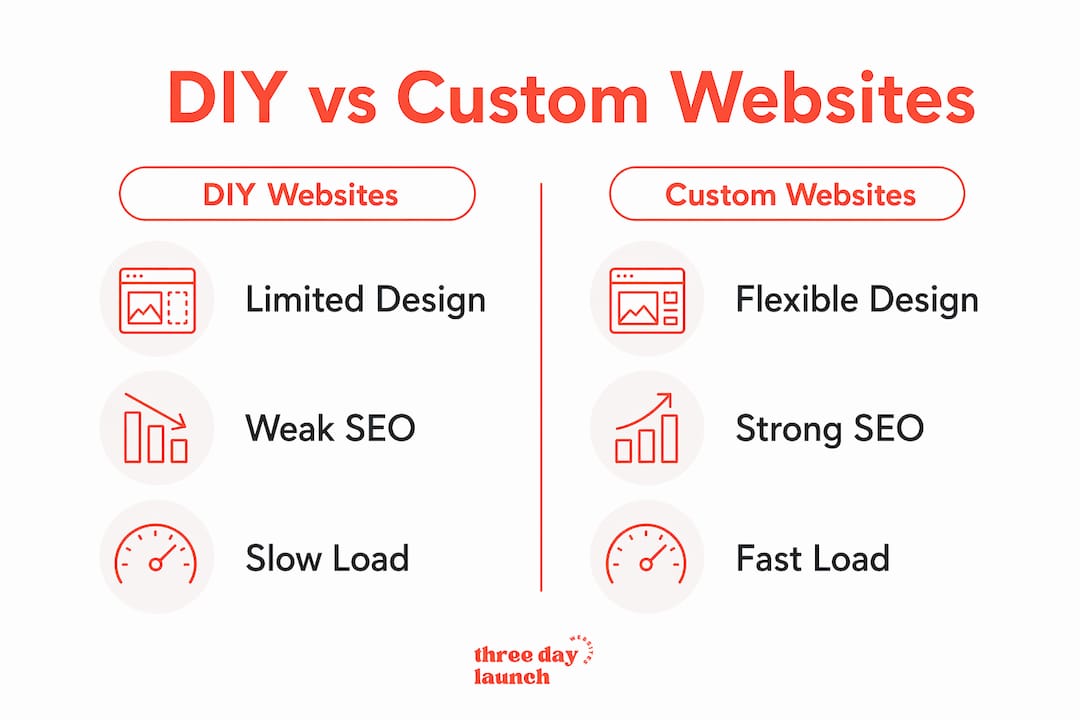
Then there is SEO, which is search engine optimization. DIY builders offer basic SEO fields, but they rarely give you control over technical SEO factors like page speed scores, structured data, canonical tags, or crawl efficiency. If Google cannot find your site easily, neither can your next client.
The compounding effect of these three issues is brutal. A slow, mobile-unfriendly, SEO-weak site does not just lose individual visitors. It systematically filters out the exact clients who are ready to invest in coaching right now.
Pro Tip: Run your current site through Google PageSpeed Insights and GTmetrix before spending another dollar on ads or content. If your mobile score is below 70, your marketing budget is partially funding a leaky bucket.
Does inconsistent messaging on DIY sites reduce client trust?
Yes, and it does so in a way that is hard to diagnose because the damage is invisible. Coaches do not lose clients because their DIY site looks terrible. They lose them because the site fails to communicate a clear, compelling reason to choose this coach over anyone else.
DIY marketing prioritizes short-term clicks over building meaningful, differentiated brand messages. This leads to simplified messaging and loss of competitive edge. When you are filling in a template's placeholder text, you write what fits the box, not what truly represents your coaching philosophy or your client transformation story.
The result is brand confusion. Visitors land on your site and cannot quickly answer three questions: What do you do? Who do you help? Why should I choose you? If those answers are not crystal clear within the first five seconds, most visitors leave.
Brand clarity also directly affects pricing. Professionally branded coaching businesses command 10 to 20% higher price premiums than competitors. That premium is not about vanity. It is about perceived value. When your site communicates authority and specificity, clients assume your coaching delivers the same.
| Brand signal | DIY site outcome | Custom site outcome |
|---|---|---|
| Visual identity | Generic, template-constrained | Unique, coach-specific design |
| Messaging clarity | Placeholder-driven, vague | Strategically written for ideal client |
| Pricing perception | Budget or mid-tier | Premium, authority-level |
| Client trust | Uncertain, requires extra convincing | Built in from first impression |
The table above is not hypothetical. It reflects the real perception gap that coaches experience every day when a prospect visits their site and quietly decides to look elsewhere.
DIY vs. custom coaching websites: what actually changes?
The honest comparison between DIY and custom sites is not just about aesthetics. It is about outcomes. Here is what shifts when coaches move from a template to a custom-designed coaching website:
| Feature | DIY website | Custom coaching website |
|---|---|---|
| Design flexibility | Limited by template structure | Built to exact brand specifications |
| SEO capability | Basic on-page fields only | Technical and on-page SEO integrated |
| Conversion optimization | Generic layout, low conversion focus | Designed around client journey and calls-to-action |
| Brand differentiation | Shared with thousands of template users | Unique to your coaching brand |
| Scalability | Constrained by platform limits | Grows with your business model |
Clients who invest in strategic copy before design get better results and faster website ROI than those starting from scratch. This is one of the most overlooked insights in the coaching space. The website is not just a design project. It is a communication strategy made visual. When copy and design are built together by professionals who understand coaching businesses, the site converts at a fundamentally different rate.
Let's Launch Your Strategic Coaching Website
Your first step is to book a free call so we can get your questions answered.
Book A Free CallThere is also the hidden cost of DIY to consider. Coaches who DIY their websites often spend nearly as much money as professional design due to consulting fees, plugin costs, and ongoing fixes, but gain far less value. The "free" website ends up costing hundreds of hours and hundreds of dollars, with a result that still underperforms.
Pro Tip: When evaluating any website investment, calculate the cost of one lost client. If your average coaching package is $2,000 and your site loses even two clients per month due to poor design or slow load times, that is $4,000 in monthly lost revenue. The math on professional design becomes obvious fast.
Key takeaways
DIY websites damage coach brands by undermining credibility, weakening messaging, and creating technical barriers that drive away ready-to-invest clients before a single conversation happens.
| Point | Details |
|---|---|
| First impressions are instant | 75% of clients judge credibility from design alone, often within milliseconds. |
| Speed is non-negotiable | Sites loading slower than 3 seconds lose visitors to faster competitors. |
| Mobile traffic is the majority | Over 60% of web traffic is mobile, and DIY sites frequently fail mobile users. |
| Messaging drives pricing | Clear, differentiated brand messaging supports 10 to 20% higher price premiums. |
| DIY costs more than it appears | Hidden consulting and fix costs often rival professional design fees with worse results. |
The real cost of "good enough" online
I have worked with coaches who spent six months building their own website, only to launch something they were embarrassed to share. The struggle is real, and I get it. DIY builders are marketed as empowering, and they can be, for a restaurant menu or a personal portfolio. But coaching is a trust-based business. Clients are not buying a product they can return. They are buying into you, your expertise, your process, and your results.
The misconception I see most often is that a DIY site is a temporary solution. "I'll fix it later when I have more clients." But here is the uncomfortable truth: the site is often why you do not have more clients yet. You cannot out-market a weak brand foundation. Spending on ads, content, or social media while your website undermines your credibility is like pouring water into a cracked cup.
The mindset shift that changes everything is treating your website as a long-term brand asset, not a task to check off. When coaches start thinking about their site the way they think about their coaching methodology, with intention, strategy, and investment, the results follow. I have seen coaches go from invisible online to fully booked within weeks of launching a site that actually represents their brand. That is not magic. That is what happens when design, copy, and strategy align.
If you are serious about your coaching business, your website needs to be serious too. Aligning your website design with your personal brand is not optional. It is the foundation everything else is built on.
— Three Day Launch
Get a custom coaching website in just three days
You do not have to choose between speed and quality. Three Day Launch builds fully custom, multi-page coaching websites in just three days, designed specifically for coaches in life, finance, health, and beyond.
Every site is built around your brand strategy, your ideal client, and your conversion goals. No templates. No cookie-cutter layouts. No months of back-and-forth. Coaches who have launched with Three Day Launch report significant increases in organic traffic, leads, and client conversions shortly after going live. If you are ready to stop losing clients to a site that does not represent what you actually offer, explore custom coaching websites built to perform from day one.
FAQ
Why do DIY websites hurt coach brands specifically?
Coaching is a trust-based business where credibility is everything. DIY sites signal generic effort rather than professional authority, and 75% of clients judge credibility from design alone, making a weak site a direct barrier to client acquisition.
How do DIY sites affect a coach's ability to charge premium prices?
Professionally branded coaching businesses command 10 to 20% higher price premiums than competitors. A DIY site signals budget positioning, which makes it harder to justify and hold premium rates.
What technical issues on DIY sites hurt client conversion?
Slow load times above three seconds, poor mobile responsiveness, and limited SEO capability are the three biggest technical barriers. Since over 60% of web traffic is mobile, a site that performs poorly on phones loses the majority of potential visitors before they read a single word.
Is a DIY website actually cheaper than hiring a professional?
Not always. Coaches who DIY their websites frequently spend nearly as much as professional design costs once consulting fees, plugin subscriptions, and ongoing fixes are factored in, while still ending up with a site that underperforms.
What should coaches look for in a professional coaching website?
Look for custom design built around your specific brand, strategic copy written before design begins, mobile-first performance, and integrated SEO. Reviewing key website features that convert visitors into clients is a strong starting point for understanding what your site actually needs.