The Role of Calls-to-Action on Coach Sites That Convert
How specific, personalized, well-placed CTAs turn coaching website visitors into booked discovery calls — with copy frameworks, placement tips, and benchmarks.
A call-to-action (CTA) is the specific prompt on a coaching website that tells a visitor exactly what to do next, and it is the single most important conversion trigger between a curious browser and a paying client. The role of calls-to-action on coach sites goes far beyond a button that says "Contact Me." When done right, CTAs reduce visitor uncertainty, build trust, and guide prospects through a decision that often involves significant personal investment. Tools like Calendly for booking and HubSpot for personalization have made it easier than ever to deploy CTAs that respond to where a visitor actually is in their decision process. This guide breaks down why CTAs matter, how to write them well, and how to measure whether they are working.
Why are calls-to-action critical for coaching website conversion?
Coaching is a high-trust, high-cost purchase. A visitor landing on your site is not browsing for entertainment. They are weighing whether you can solve a real problem in their life or business. Without a clear next step, they leave. With the wrong next step, they hesitate. The role of CTAs in client engagement is to remove that hesitation by giving visitors a specific, low-risk path forward.

Think about the difference between a vague "Get in Touch" button and a specific "Reserve Your Free 30-Minute Clarity Session" link. The second version tells the visitor exactly what they are committing to, how long it takes, and what they will get out of it. Specific discovery call CTAs that detail duration and outcome reduce visitor anxiety and increase bookings. That is not a minor tweak. That is the difference between a site that fills your calendar and one that collects dust.
Here is what vague CTAs cost you in practice:
- Visitors do not know what happens after they click, so they do not click.
- Generic language signals a generic coaching experience, which undermines your positioning.
- Missed micro-commitments mean visitors exit without any relationship formed.
- You lose the chance to qualify leads before a call even happens.
"CTAs for coaches should act as trust-building, low-risk next steps rather than high-pressure sales commands." This framing matters because coaching prospects are often in a vulnerable place. They need to feel invited, not pushed.
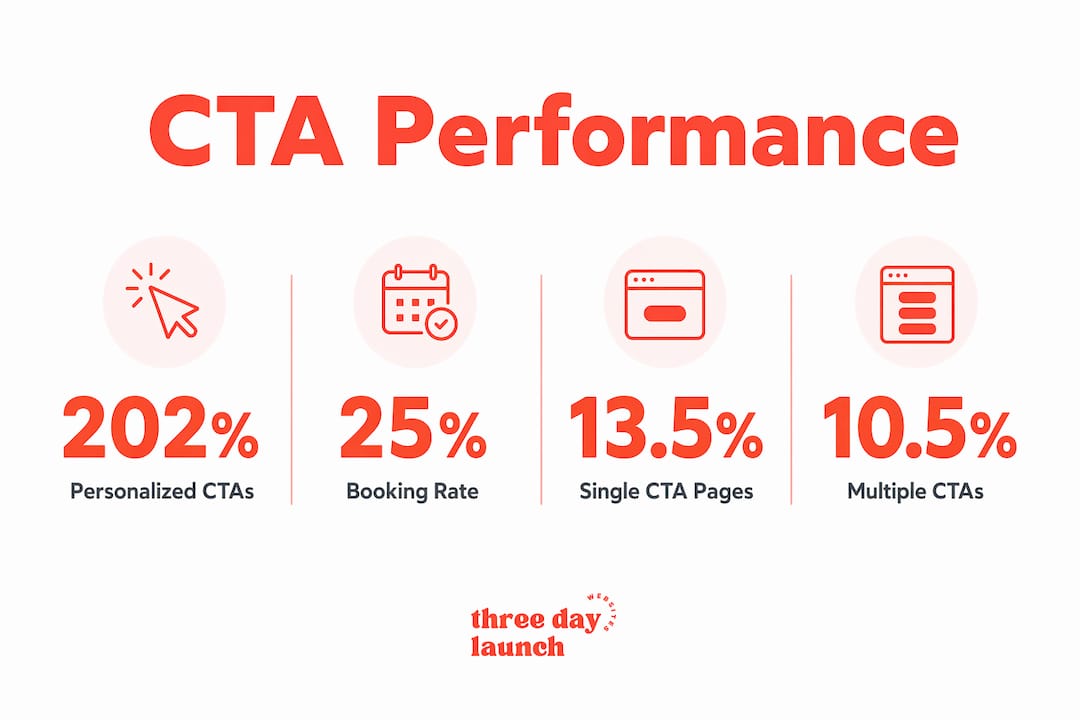
Direct booking CTAs linked to scheduling tools convert at an estimated 25% from discovery calls to paying coaching clients. That number puts the stakes in perspective. Every visitor who leaves without clicking a CTA is a potential client your competitors will eventually reach.
How to craft effective calls-to-action tailored for coaches
Writing a CTA that converts is less about clever copywriting and more about clarity and empathy. Here is a practical framework coaches can follow:
-
Start with an action verb that creates momentum. Words like "Reserve," "Start," "Book," and "Claim" signal forward movement. "Submit" and "Click Here" signal nothing.
-
Name the benefit, not just the action. "Book a Call" tells visitors what to do. "Book a Call and Get a Clear Plan for Your Next 90 Days" tells them why it is worth their time.
-
Add a risk mitigator. Words like "free," "no obligation," and "cancel anytime" lower the perceived cost of clicking. Coaching prospects are often skeptical. Give them permission to say yes without feeling trapped.
-
Explain what happens after the click. A short line beneath your CTA button, such as "You'll pick a time that works for you and receive a confirmation email," removes the mystery. Mystery kills conversions.
-
Match commitment level to funnel stage. A visitor reading your blog for the first time is not ready to book a six-month program. Offer them a free resource or a short video first. Matching CTA commitment to visitor readiness increases transactions by 28%.
-
Use one primary CTA per page. Single-CTA pages convert at about 13.5%, while pages with three or more CTAs drop to 10.5%. Giving visitors too many options is the same as giving them no direction at all.
Pro Tip: Write your CTA copy from the visitor's perspective, not yours. Instead of "Schedule a Consultation," try "Get My Free Strategy Session." The shift from second to first person makes the action feel like something the visitor is choosing, not something you are asking for.
You can find more examples of CTA copy that converts in coaching contexts, including real language that has worked for life, health, and finance coaches.
What is the impact of CTA personalization and placement for coaching sites?
Placement and personalization are where most coaching websites leave serious conversion gains on the table. You can write a perfect CTA and still bury it where no one sees it, or show it to the wrong visitor at the wrong time.
Personalized CTAs convert 202% better than generic static ones, based on HubSpot's 2026 dataset across 330,000 CTAs. That is not a marginal improvement. It means a visitor who has already downloaded your free guide should see a different CTA than someone visiting your homepage for the first time. Mapping CTAs to lifecycle segments rather than using one generic prompt everywhere is the standard for high-performing coaching sites.
Here is how placement strategy breaks down across a typical coaching website:
Let's Launch Your Strategic Coaching Website
Your first step is to book a free call so we can get your questions answered.
Book A Free Call| Placement | Best use case | Conversion impact |
|---|---|---|
| Homepage hero (above the fold) | Primary CTA for cold visitors | Highest visibility, sets first impression |
| Mid-content (blog or about page) | Warm visitors already engaged | Catches readers at peak interest |
| End of page | Visitors who read everything | Captures high-intent prospects |
| Pop-up or sticky bar | Returning visitors or exit intent | Recovers visitors about to leave |
Above-the-fold and mid-content CTAs outperform those buried at the bottom of a page by over 300%. That stat alone should prompt you to audit where your primary CTA currently lives on your homepage.
A few placement principles worth following:
- Never make a visitor scroll to find your primary CTA on the homepage.
- Repeat your main CTA at least twice on long-form pages.
- Use scheduling tools like Calendly or Acuity directly in your CTA flow. Scheduling tools reduce friction by enabling immediate booking, cutting the gap between "I want to book" and a confirmed appointment.
- Keep CTA button styling consistent across your site. Inconsistent colors and fonts signal a disorganized brand, which erodes trust.
How to measure, test, and optimize CTAs for coach websites
Most coaches set up a CTA once and never look at it again. That is a missed opportunity. CTA performance is a living metric, and small changes in wording, color, or placement can produce meaningful shifts in bookings.
The metrics that matter most are views, clicks, click rate, and downstream bookings. Click rate tells you whether your CTA is compelling enough to act on. Downstream bookings tell you whether the people clicking are actually converting into clients. HubSpot's personalization tool tracks views, clicks, and click rates across content variants, making it straightforward to compare which version of a CTA performs better with specific visitor segments.
The key principle here is that CTA performance is a funnel metric, not a single-click metric. A CTA with a high click rate but low booking rate signals a mismatch between what the button promises and what the visitor finds after clicking. That gap is where you lose clients.
Pro Tip: Run one A/B test at a time. Change only the CTA button text, or only the placement, or only the color. Testing multiple variables simultaneously makes it impossible to know what actually drove the result.
A simple testing cycle for coaching sites looks like this: run your current CTA for four weeks, record click rate and bookings, change one element, run for another four weeks, and compare. Aligning CTAs to visitor intent throughout the funnel is what separates coaches who fill their programs from those who wonder why traffic is not converting. You can dig deeper into how coach websites generate leads to see how CTA optimization fits into a broader conversion strategy.
Key takeaways
Effective CTAs on coaching websites are specific, personalized, and placed where visitors are most engaged, and they are the primary driver of turning site traffic into booked discovery calls.
| Point | Details |
|---|---|
| Specificity beats vagueness | Replace "Book a Call" with a CTA that names the duration, format, and outcome of the session. |
| One CTA per page wins | Single-CTA pages convert at 13.5% versus 10.5% for pages with three or more CTAs. |
| Personalization multiplies results | Personalized CTAs convert 202% better than generic ones, per HubSpot's 2026 dataset. |
| Placement is not an afterthought | Above-the-fold and mid-content CTAs outperform bottom-of-page placements by over 300%. |
| Measure downstream, not just clicks | Track bookings and revenue from each CTA, not just click rates, to see the full picture. |
What I've learned from watching coaches get CTA strategy wrong
Here is the honest truth: most coaches treat their CTA like a formality. They add a button because they know they are supposed to, pick a color that looks nice, and move on. Then they wonder why their traffic is not converting.
What I have seen work, time and again, is treating the CTA as the most important sentence on the page. Not the headline. Not the bio. The CTA. It is the moment where a visitor decides whether to trust you enough to take one small step. That step is not signing a contract. It is booking a 30-minute call. But it feels enormous to someone who has never worked with a coach before.
The coaches who fill their calendars are the ones who write CTAs with empathy. They think about what their visitor is afraid of, what they are hoping for, and what would make clicking feel safe. "Reserve Your Free Clarity Call, No Obligation" does more psychological work than most coaches realize. It names the action, removes the cost, and eliminates the fear of being sold to.
I also want to push back on the idea that personalization is too complicated for most coaches. You do not need a complex tech stack to start. You need two versions of your CTA: one for cold visitors and one for people who have already engaged with your content. That alone, done consistently, moves the needle. The trust-building role of personalized CTAs is something every coach can leverage without a marketing team.
Stop treating your CTA as a button. Treat it as an invitation.
— Three Day Launch
Get a coaching website built around CTAs that actually convert
If your current website is not turning visitors into discovery calls, the problem is almost always the CTA strategy, not the traffic. Three Day Launch builds custom coaching websites in three days, designed from the ground up to convert. Every page is structured around clear, specific CTAs that guide your visitors toward booking, with Calendly integration built in so there is zero friction between interest and appointment.