9 Signs Your Coaching Site Needs a Redesign in 2026
Nine measurable signs your coaching website is costing you clients — slow speed, weak messaging, flat conversions — plus how to fix each one fast.

Signs your coaching site needs redesign are visible, measurable indicators like slow page load speeds, low mobile conversions, and outdated visuals that quietly cost you clients every day. Your website is your storefront and your handshake. When it stops working, potential clients leave without ever reaching out. The good news is that these indicators are not guesswork. They show up in your analytics, your bounce rate, and your booking flow. Knowing what to look for puts you back in control.
1. Your page speed is driving visitors away
Slow load times are the fastest way to lose a potential client before they read a single word. 53% of mobile visitors abandon a page that takes longer than 3 seconds to load. That means more than half your mobile audience never sees your offer.

Page speed also affects your Google ranking directly. A sluggish site signals poor user experience to search engines, which pushes you further down the results page. The connection between faster website speed and higher conversions is well established.
Pro Tip: Run your site through Google PageSpeed Insights right now. It is free, takes 60 seconds, and shows you exactly where your site is losing speed.
- Pages taking over 3 seconds lose more than half of mobile visitors
- Slow sites rank lower in Google search results
- Poor speed signals low credibility to first-time visitors
2. Your mobile experience is broken
A coaching website that requires visitors to pinch and zoom to read your content has a broken mobile experience. Mobile conversion rates below half of desktop rates are a primary redesign trigger. That gap tells you your mobile layout is actively blocking clients from booking.
Most coaches book clients through mobile searches. If your site is not built to convert on a small screen, you are handing those leads to someone else. Check your Google Analytics to compare mobile versus desktop conversion rates. If the gap is wide, a redesign is not optional.
3. Your design looks dated
Outdated fonts, cluttered layouts, and unclear messaging are immediate visual cues that your site needs attention. Visitors form a first impression in milliseconds. A design that looked fresh in 2019 now signals that your business has not kept up.
Dated design does not just look bad. It erodes trust. Coaches who work in premium niches like executive coaching or health coaching lose credibility fast when their site looks like a template from a decade ago. The visual identity of your site should match the quality of your coaching.
- Old or mismatched fonts that clash with your brand
- Cluttered homepages with too many competing elements
- Stock photos that feel generic and impersonal
- Color schemes that feel heavy or outdated
4. Your messaging fails the 3-second test
A visitor should know exactly who you help and what you offer within 3 seconds of landing on your homepage. The 3-second rule for messaging clarity is a real benchmark, and most coaching sites fail it. Vague headlines like "Helping you reach your potential" tell the visitor nothing specific.
Clear messaging answers three questions instantly: Who is this for? What do they get? Why should they trust you? If your homepage headline does not answer all three, visitors bounce. This is one of the most common coaching site content mistakes, and it is also one of the easiest to fix without a full rebuild.
Pro Tip: Ask a friend who has never seen your site to look at your homepage for 3 seconds, then close it. Ask them what you do. If they cannot answer clearly, your messaging needs work.
5. Your content no longer matches your business
Your website might describe services you no longer offer or speak to an audience you have moved on from. This mismatch is one of the clearest indicators for site redesign. It confuses visitors and attracts the wrong clients.
Coaches evolve. A life coach who has moved into executive coaching needs a site that reflects that shift. A health coach who now runs group programs needs a booking flow built for groups, not one-on-one calls. When your site and your business tell different stories, the site loses every time. Aligning your website elements for client attraction with your current offer is non-negotiable.
6. Your conversion rates have been flat for months
Flat or declining conversion rates on key pages are a strong signal that something structural is broken. Conversions declining for three consecutive quarters indicate a redesign targeting conversions is highly recommended. Nine months of stagnant results is not a bad patch. It is a pattern.
Conversion in a coaching context means contact form submissions, discovery call bookings, and pricing page clicks. If visitors land on your site but never take action, the problem is usually friction in the user journey. Booking flows that are too long, unclear calls to action, or pricing pages with no next step all kill conversions. Here is a quick reference for common conversion problems and what they signal:
| Conversion problem | What it signals |
|---|---|
| Low contact form submissions | Unclear value proposition or buried form |
| High pricing page bounce rate | Lack of trust signals or confusing pricing structure |
| Long booking flow drop-off | Too many steps or poor mobile booking experience |
| Low discovery call completions | Misaligned messaging attracting wrong audience |
Understanding what converts on coaching sites helps you diagnose which pages need the most attention first.
7. Your site has not had a major update in over 2 years
The industry average for a structural redesign is every 2.5 years. If your last major overhaul was before that window, your site is likely falling behind current design standards, SEO requirements, and user expectations.
This is not about chasing trends. Web technology, accessibility standards, and search engine algorithms all shift over time. A site built on older architecture may have technical debt that slows it down and limits what you can add. Knowing when to redesign your coaching site often comes down to this simple timeline check.
8. Your site lacks authority signals for AI search
Let's Launch Your Strategic Coaching Website
Your first step is to book a free call so we can get your questions answered.
Book A Free CallAI-powered search tools like Google's AI Overviews and Perplexity now surface answers directly in search results. Sites lacking clear authority signals see click-through rates drop by nearly 50% in AI-driven search environments. That is a massive visibility loss for coaches who rely on organic traffic.
Authority signals include original content, clear expertise positioning, and structured page architecture. A site that reads as generic or template-based gets skipped by AI citation systems. Updating old content is one of the fastest ways to rebuild authority before committing to a full redesign.
9. Your business has repositioned but your brand has not
A rebrand, a new niche, or a shift in your ideal client profile all require a corresponding website update. Coaches who ignore this disconnect end up attracting clients who are no longer the right fit. That wastes everyone's time and dilutes your positioning.
Business triggers that call for revamping your coaching website include:
- Launching a new signature program or group offer
- Shifting from general coaching to a specialized niche
- Raising your prices and moving upmarket
- Rebranding with a new name, logo, or visual identity
- Targeting a new audience segment entirely
The coaching website design process should always reflect where your business is going, not where it has been.
Key Takeaways
A coaching website that shows multiple signs of poor performance, outdated design, or misaligned messaging will consistently underperform at attracting and converting ideal clients.
| Point | Details |
|---|---|
| Speed and mobile experience | Pages over 3 seconds lose more than half of mobile visitors, making speed a top redesign priority. |
| Messaging clarity | Visitors decide within 3 seconds whether your site speaks to them, so your homepage headline must be specific. |
| Conversion rate decline | Flat or declining conversions for 9+ months signal structural problems that require a redesign. |
| Redesign timing | The industry benchmark for a structural redesign is every 2.5 years. |
| Business alignment | Any major shift in niche, pricing, or audience requires a corresponding site update to stay credible. |
What I have learned from watching coaches ignore these signs
Here is the uncomfortable truth we see at Three Day Launch all the time. Most coaches know their site is not working. They feel it. But they put off fixing it because a redesign sounds expensive, slow, and complicated. So they keep sending traffic to a site that quietly turns people away.
The smarter move is to use a scoring approach before committing to a full rebuild. Count how many signs from this list apply to your site. Three to five signs usually mean targeted improvements to specific pages. Six or more signs typically mean a full redesign is more cost-effective than patching things one by one.
One thing I always tell coaches: fix your foundational visibility issues before spending money on a redesign. That means your Google Business profile, your domain consolidation, and at least some original blog content. A redesigned site built on a weak foundation still will not rank.
Focus your first redesign energy on three pages: your homepage, your primary service page, and your booking or contact page. Those three pages drive the majority of client decisions. Get those right and the rest of the site follows.
A faster path to a site that actually books clients
If you counted more than five signs from this list, your site is actively working against you. The longer it stays that way, the more potential clients land on it and leave.
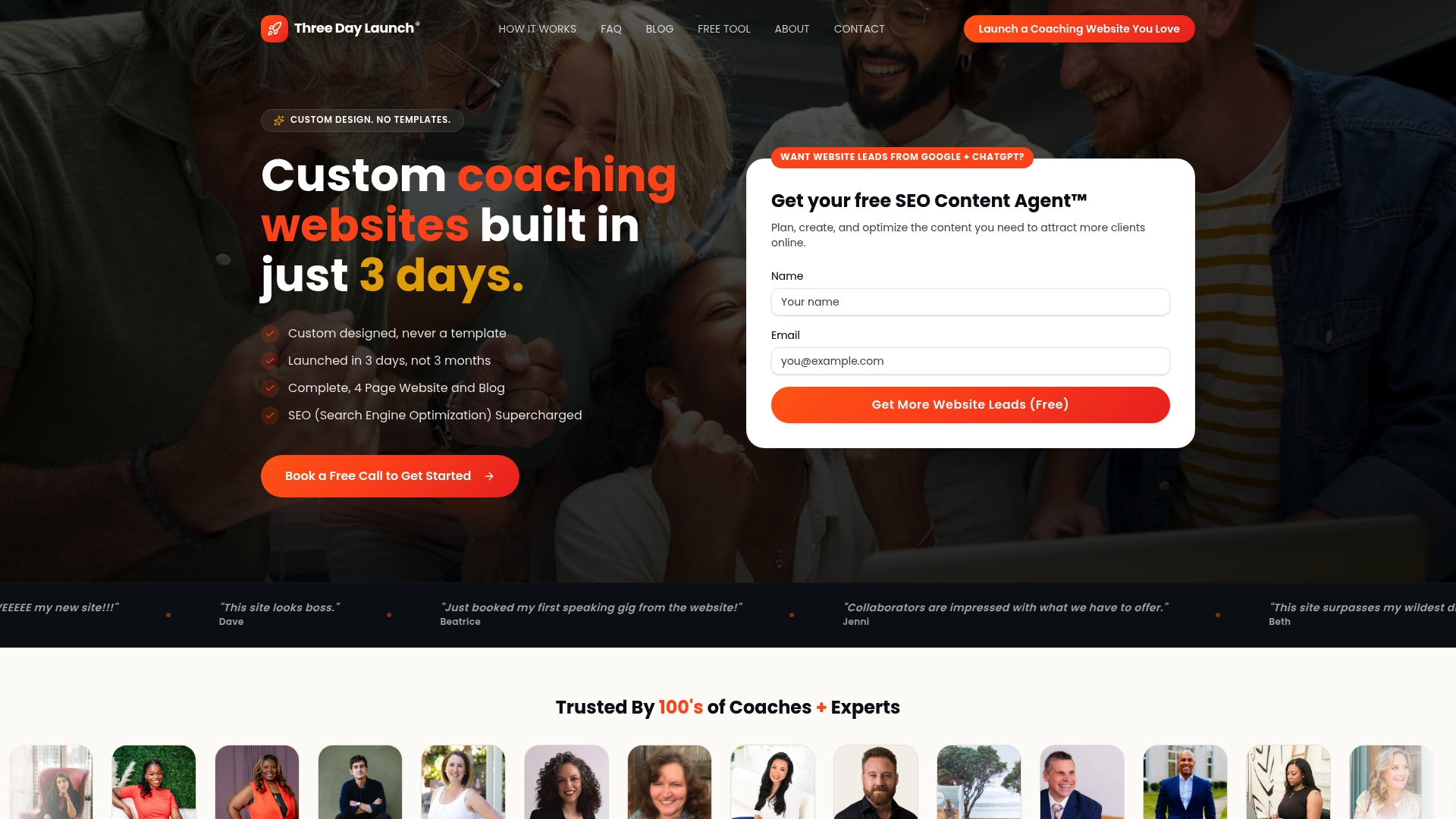
Three Day Launch builds fully custom, multi-page coaching websites in just three days. No templates, no months-long timelines, and no guessing whether your site will convert. Coaches in life, health, finance, and executive niches have used Three Day Launch to go from a broken site to a custom coaching website that attracts leads and books clients from organic traffic. If your site is showing the signs, the fix does not have to take forever.
FAQ
How many signs mean I need a full redesign?
A scoring system suggests that 3–5 signs call for a partial redesign, while 6 or more signs typically make a full rebuild more cost-effective than incremental fixes.
How often should a coaching website be redesigned?
The industry benchmark is a structural redesign every 2.5 years. If your conversion rates have also been declining for three or more consecutive quarters, that timeline moves up.
What is the fastest way to check if my site needs a redesign?
Run your site through Google PageSpeed Insights for performance data, then apply the 3-second messaging test on your homepage. Those two checks reveal the most common coaching website issues in under five minutes.
Does a slow website really affect client bookings?
Yes. 53% of mobile visitors leave a page that takes longer than 3 seconds to load. Since most coaching clients search on mobile, slow speed directly reduces the number of people who ever see your offer.
Can I fix these issues without a full redesign?
Sometimes. If you have three or fewer signs, targeted improvements to specific pages may be enough. If your site has deeper structural or visual problems, a full rebuild typically delivers better results faster than patching individual issues.