What Is a Coach Bio Page? Build One That Converts
A coach bio page is a dedicated web page that tells potential clients who you help, what results you deliver, and why they should trust you enough to book a session. It is not a resume. It is not a personal history. It is a client acquisition tool built to turn curious visitors into paying clients.…
A coach bio page is a dedicated web page that tells potential clients who you help, what results you deliver, and why they should trust you enough to book a session. It is not a resume. It is not a personal history. It is a client acquisition tool built to turn curious visitors into paying clients. Most coaches get this wrong from the very first sentence. This article breaks down exactly what a coach bio page needs, how long it should be, and how to write one that actually works for your coaching or fitness business.
What is a coach bio page and why does it matter?
A coach bio page is the section of your website where you introduce yourself in a way that speaks directly to your ideal client's goals and problems. The industry term for this is a "coaching profile page," and it functions as one of the highest-converting pages on any coaching website when it is built correctly.
The importance of a coach bio cannot be overstated. Visitors land on your page with one question in mind: "Can this person help me?" Your bio answers that question in seconds or loses the lead entirely. A strong coach profile page does three things at once. It qualifies your ideal client, builds credibility through proof, and guides the visitor toward a clear next step.

Generic bios fail because they are written for the coach, not the client. A bio that opens with "Hi, I'm a certified life coach with 10 years of experience" tells the visitor nothing about their own situation. A bio that opens with "I help busy professionals cut their stress in half and reclaim their evenings" speaks directly to a real person with a real problem. That distinction is everything.
What key elements compose an effective coach bio page?
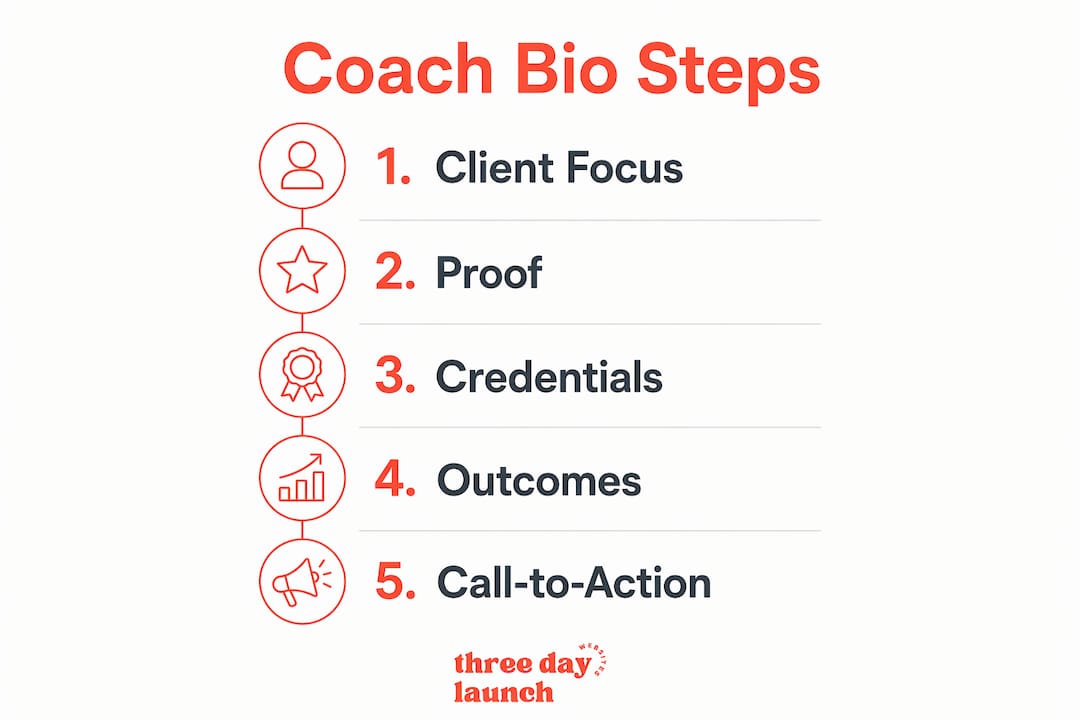
An effective coach bio page is built around five core components. Each one serves a specific purpose in moving a visitor from curious to committed.
- A client-centered opening statement. The most effective coaching bios open with the pattern "I help [specific person] achieve [specific result]." This immediately signals relevance and filters out visitors who are not your ideal client.
- Measurable outcomes. Vague promises do not convert. Specific outcomes like "helped 40 clients lose their first 20 pounds" or "supported executives in reducing decision fatigue by restructuring their weekly schedules" give visitors a concrete picture of what working with you looks like.
- Credentials and trust signals. Certifications from organizations like the International Coaching Federation (ICF), National Academy of Sports Medicine (NASM), or Precision Nutrition carry weight. Place them after your outcome statement, not before. You earn the right to introduce yourself by leading with the client's problem first.
- Social proof. Testimonials alongside outcome-driven claims significantly increase bio conversion. A single specific quote from a past client does more work than three paragraphs of self-description.
- A single, direct call to action. One clear CTA like "Book your free discovery call below" tells the visitor exactly what to do next. Multiple CTAs split attention and reduce bookings.
Pro Tip: Write your opening sentence last. Draft the rest of your bio first, then craft the opening statement once you are clear on the specific outcome you want to lead with.
The biggest mistake coaches make is treating their bio like a LinkedIn profile. Your coach profile page is not about your background. It is about your client's future.
How long should a coach bio page be?
Bio length is not a style preference. It is a conversion variable, and the research is clear on what works.
| Bio context | Recommended length | Primary goal |
|---|---|---|
| Booking or landing page | 60–100 words | Fast conversion, immediate action |
| About page | 200–400 words | Trust building, deeper connection |
| LinkedIn or social profile | 150–200 words | Professional credibility, discoverability |
| Speaker or media bio | 100–150 words | Authority positioning, third-person format |
Visitors on booking pages make decisions in 5–10 seconds. That window is too short for a 500-word life story. A 60–100 word conversion bio respects that attention span and delivers only what the visitor needs to say yes.
Your About page operates differently. Visitors who navigate to your About page are already interested. They want more context, more story, and more proof. A 200–400 word extended bio works well here because the visitor has self-selected into a deeper research phase.
Pro Tip: Never copy and paste the same bio across your booking page, About page, and LinkedIn profile. Each platform attracts visitors at a different stage of the decision process, and mixing bio types consistently produces poor conversion rates.
Length discipline also forces clarity. When you have only 80 words to work with, every sentence has to earn its place. That constraint is actually a gift.
What mistakes do coaches most often make on bio pages?
Most coaching bios read like resumes. 80% of generic "Hi, I'm a certified coach" intros fail to engage users. That is a significant number of missed opportunities sitting on coaching websites right now.
Here are the most common mistakes and how to fix them:
- Leading with credentials. Credentials belong in your bio, but not at the top. Open with the client's problem or desired outcome, then introduce your qualifications as supporting evidence.
- Targeting everyone. "I work with anyone who wants to improve their life" is not a niche. It is a red flag. Coaches who niche their bio outperform broad, generic bios because specificity attracts higher-quality leads who are more likely to convert.
- Skipping measurable results. "I help clients reach their potential" means nothing. "I help new managers lead their first team without burning out in the first 90 days" means something specific and searchable.
- Using a passive call to action. A CTA like "feel free to reach out" is ineffective by design. It places the burden on the visitor and signals low confidence. Replace it with "Book your free 30-minute call below" and watch your booking rate change.
- Using one bio everywhere. Your website landing page bio, your Instagram bio, and your booking page bio serve different purposes. Writing one version and pasting it everywhere is a shortcut that costs you clients.
Fixing these mistakes does not require a complete website overhaul. In most cases, rewriting the first two sentences and replacing a passive CTA with a direct one produces measurable results within weeks.
How to tailor your coach bio for different platforms
A single bio cannot serve every context. Successful coaches maintain multiple versions, each calibrated to the platform and the visitor's intent. Here is how to think about it:
-
Booking page bio (60–100 words). This is your conversion bio. It leads with the client outcome, includes one trust signal, and ends with a direct CTA. No personal backstory. No list of certifications. Just the essentials that move someone from reading to booking.
-
About page bio (200–400 words). This is your trust bio. It can include your personal story, your coaching philosophy, and a few client results. Visitors here want to know who you are as a person, not just what you do. This is where a quote from a past client or a brief mention of your own transformation story fits naturally.
-
LinkedIn profile bio (150–200 words). LinkedIn visitors are often in professional development mode. Your tone here can be slightly more formal. Lead with your specialty, include measurable outcomes, and add a soft CTA like "Connect with me to learn more." Good coach website copy principles apply here too.
Let's Launch Your Strategic Coaching Website
Your first step is to book a free call so we can get your questions answered.
Book A Free Call-
Social media bio (under 150 characters). Instagram and Facebook give you almost no room. Use a single sentence that states your niche and outcome. "Helping new moms rebuild strength after birth. DM me to start." That is it. Link to your booking page.
-
Speaker or media bio (100–150 words, third person). Event organizers and podcast hosts need a third-person bio they can read aloud or paste into a program. Write this version as if someone else is introducing you. Focus on authority, credentials, and notable client results.
The key insight here is that each bio version targets a different stage of the buyer journey. Your booking page bio targets someone ready to act. Your About page bio targets someone still deciding. Your LinkedIn bio targets someone discovering you for the first time. Treat them as separate tools, not variations of the same document.
Pro Tip: Keep a "bio vault" document where you store all five versions. Update them together whenever your niche, outcomes, or credentials change. Outdated bios on any platform can quietly undermine trust.
Key takeaways
A coach bio page converts visitors into clients when it leads with the client's outcome, backs it with proof, and ends with a direct call to action.
| Point | Details |
|---|---|
| Lead with client outcomes | Open with "I help [specific person] achieve [specific result]" to capture attention immediately. |
| Match bio length to context | Use 60–100 words for booking pages and 200–400 words for About pages to match visitor intent. |
| Use specific social proof | Testimonials and measurable results convert better than credential lists alone. |
| Write one CTA per bio | A single direct call to action like "Book your free call below" outperforms passive alternatives. |
| Maintain multiple bio versions | Tailor your bio for each platform and buyer journey stage to avoid poor conversion rates. |
Why most coach bios are one rewrite away from working
Here is what I have seen over and over again working with coaches across life, fitness, and finance niches: the bio is almost always good. The coach has real results, real credentials, and a genuine passion for their work. The problem is the order.
Coaches lead with themselves when they should lead with the client. It is a natural instinct. You worked hard for your certifications. You want people to know that. But the visitor does not care about your ICF credential in the first sentence. They care about whether you can solve their specific problem. Once you flip that order, everything changes.
I also see coaches treat their CTA as an afterthought. They write a compelling bio and then end with "feel free to reach out if you have questions." That is leaving money on the table. A strong CTA is not pushy. It is respectful. It tells the visitor exactly what to do next and removes the friction of figuring it out themselves. Pairing a strong bio with high-converting CTAs is one of the fastest ways to improve your booking rate without changing anything else on your site.
The other thing I would push back on is the idea that niching down limits you. It does the opposite. When a fitness coach writes a bio specifically for postpartum women returning to strength training, that bio does not repel other clients. It attracts the exact client who reads it and thinks, "This person gets me." That feeling of being understood is what converts browsers into buyers.
— Three Day Launch
Build a coach bio page that actually books clients
Your bio is often the first real impression a potential client gets of you. A well-built coach website puts your bio in the right place, with the right words, and the right CTA to turn that impression into a booking.
Three Day Launch builds custom websites for coaches in three days, not three months. Every site includes professionally written copy, bio pages designed to convert, and a structure built around your specific niche and client goals. If you are ready to stop losing leads to a bio that undersells you, get your custom coach website built by a team that understands how coaching clients actually make decisions. You can also explore what makes coach websites convert before you build.
FAQ
What is the purpose of a coach bio page?
A coach bio page communicates who you help, what results you deliver, and why a visitor should trust you enough to book a session. It functions as a client acquisition tool, not a professional history.
How long should a coach bio be?
Booking and landing page bios should be 60–100 words to match visitor attention spans of 5–10 seconds. About page bios can run 200–400 words to build deeper trust with visitors who are already interested.
What should I include in a coach bio?
A strong coach bio includes a client-centered opening statement, at least one measurable outcome, relevant credentials, social proof like a client testimonial, and a single direct call to action.
Why does niche targeting improve a coach bio?
Specificity in client targeting is a conversion mechanism. Coaches who write for one exact client type attract higher-quality leads who are more likely to book, compared to coaches who write for a broad, undefined audience.
Can I use the same bio on every platform?
No. Each platform serves a different stage of the buyer journey, and mixing bio types produces poor conversion rates. Maintain separate versions for your booking page, About page, LinkedIn profile, and social media accounts.