Why Solopreneurs Invest in Custom Sites: 2026 Guide
A custom website is the single most controllable sales asset a solopreneur owns. Here's the concrete business case for investing in custom design in 2026.

A custom website is the single most controllable sales asset a solopreneur owns. Unlike social media profiles or third-party listing pages, your site sets the rules on branding, user experience, and lead capture. That's exactly why solopreneurs invest in custom sites at a growing rate: the business case is concrete, measurable, and increasingly urgent as generic templates flood every market niche. Custom web design, the industry term for building a site from the ground up to match your specific brand and goals, delivers what no template can replicate: a site that works for your business, not around it.
Why solopreneurs invest in custom sites: branding and visual authority
Your website is your storefront and your handshake. Visitors decide whether to trust you before they read a single word. Research shows brand credibility forms in as little as 50 milliseconds. That means your visual design either earns trust instantly or loses it just as fast.
Generic templates create what designers call "brand amnesia." When your site looks like thousands of others, visitors feel nothing. They leave without remembering you. Custom design gives you control over every visual element, from typography and color palette to imagery and layout, so your personality comes through immediately.

Templates constrain your content to pre-built layouts, forcing your story into someone else's framework. That limits how specifically you can speak to your ideal client's pain points. A custom site lets you lead with your client's problem, then walk them straight to your solution.
Aligning your website design with your personal brand also supports premium positioning. When your site, your social presence, and your offline materials share a consistent visual identity, you signal professionalism without saying a word about it.
Here's what custom design actually controls for your brand:
- Color and typography: Chosen to match your brand personality, not a template's default palette
- Imagery: Real photos and custom graphics that reflect your actual work and clients
- Layout flow: Pages structured around your sales process, not a generic homepage formula
- Tone and copy placement: Headlines and calls to action positioned where your specific audience expects them
Pro Tip: Before briefing any designer, write down three words that describe how you want clients to feel when they land on your site. Those three words should drive every visual decision.
What is the measurable ROI of a custom website for solopreneurs?
The business case for custom web design is not abstract. Businesses investing in custom development typically achieve ROI within 8–14 months through better lead conversions, improved search rankings, and lower maintenance costs. That timeline is faster than most solopreneurs expect.
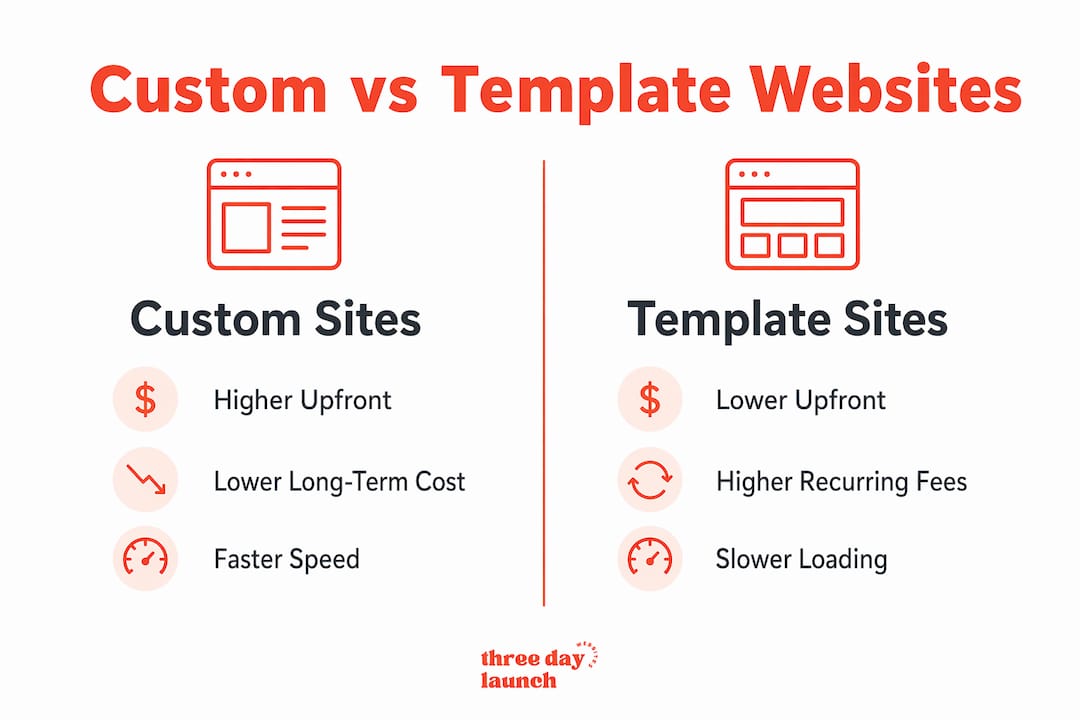
Site speed is a major driver. Custom sites regularly score 90+ on Google PageSpeed Insights, while template-based sites typically score 70–80. Google uses page speed as a direct ranking factor, so that gap translates to real differences in organic search visibility.
Faster pages also keep visitors engaged. A slow site pushes people away before they see your offer. A fast, well-structured custom site reduces bounce rates and moves visitors through your sales funnel more efficiently. That efficiency shows up in your inquiry rate and your revenue.
Tailored websites outperform generic templates in conversion and branding because every element serves a specific purpose. A custom build lets you add lead capture forms exactly where visitors are ready to act, integrate your booking tool without workarounds, and A/B test landing pages without fighting a template's structure.
The cost picture also shifts when you look at total cost of ownership (TCO). TCO is the full cost of a tool over time, including setup, maintenance, and hidden fees.
| Cost factor | Template sites | Custom sites |
|---|---|---|
| Upfront cost | Low | Higher |
| Monthly plugin fees | Recurring and growing | Minimal |
| Developer fixes for layout breaks | Frequent | Rare |
| SEO performance ceiling | Limited by theme | No ceiling |
| Long-term TCO | Often higher | Lower over time |
Custom-built sites reduce long-term TCO by cutting plugin bloat, expensive subscriptions, and the recurring cost of fixing layout breaks. The upfront investment looks larger, but the five-year math usually favors custom.
Pro Tip: Ask any web designer for a TCO estimate over three years, not just the build cost. That single question separates serious partners from cheap-and-fast vendors.
How does a custom site scale with your solopreneur business?
Templates have a feature ceiling. When your business grows and you need a membership portal, a complex booking system, or a custom API integration, templates force expensive workarounds. Those workarounds create technical debt, meaning you pay more and more to maintain a site that was never built for your actual needs.
Custom sites avoid that trap. Here's how they support growth at each stage:
- Launch phase: Build only what you need now, with clean code that makes future additions straightforward.
- Growth phase: Add membership areas, course platforms, or client portals without rebuilding from scratch.
- Scale phase: Integrate CRM tools, email marketing platforms, and payment systems through direct API connections, not third-party plugins that slow your site down.
- Migration phase: If you ever move hosts or redesign, you own the code and the content. No platform holds your site hostage.
Ownership matters more than most solopreneurs realize. Custom sites give you ownership of both design and backend, which means you control your hosting, your URL structure, and your SEO equity. Template platforms can change their pricing, discontinue features, or shut down entirely. Your custom site goes nowhere without your permission.
Protecting your SEO during a site migration is a concrete example of why this matters. Careful migration planning with content mapping and proper URL redirects lets you switch from a template to a custom site without losing your organic rankings. That kind of control is simply not available when a platform owns your site structure.
Understanding how coach websites generate leads that actually convert requires a site architecture built around your specific client path. Templates give you a generic path. Custom sites give you yours.
Are custom websites hard to maintain and update?
The biggest myth about custom web design is that you need a developer on speed dial to change a headline. That hasn't been true for years. Modern custom websites commonly use WordPress as a content management system (CMS), giving you a simple editing interface for text, images, and pages. You update your own content without touching a line of code.
Here's what you actually control yourself on a well-built custom site:
Let's Launch Your Strategic Coaching Website
Your first step is to book a free call so we can get your questions answered.
Book A Free Call- Blog posts and new pages
- Images and video embeds
- Service descriptions and pricing
- Contact forms and lead capture fields
- Testimonials and case studies
Structural changes, like adding a new section type or a complex integration, still benefit from a developer. But those changes are infrequent and planned. The day-to-day running of your site is fully in your hands.
The cost comparison also shifts when you account for what templates actually charge over time. Plugin subscriptions, premium theme renewals, and page builder fees add up fast. Understanding TCO helps solopreneurs see that a higher upfront custom build cost often pays off within the first year or two by eliminating those recurring charges.
Choosing the right development partner matters as much as the decision to go custom. Look for a partner who builds on a CMS you can edit, provides training on your own site, and documents the work so you're never dependent on one person to make changes.
Pro Tip: Before signing with any web designer, ask: "Will I be able to update my own text and images after launch?" If the answer is anything other than a clear yes, keep looking.
Key Takeaways
Custom websites deliver measurable ROI, stronger branding, and long-term scalability that template sites cannot match for solopreneurs.
| Point | Details |
|---|---|
| ROI timeline | Custom sites typically return the investment within 8–14 months through better leads and lower maintenance costs. |
| Visual authority | Brand credibility forms in 50 milliseconds, making custom design a direct trust-building tool. |
| SEO performance | Custom sites score 90+ on Google PageSpeed Insights versus 70–80 for templates, improving search rankings. |
| Lower long-term cost | Custom builds reduce plugin fees and recurring fixes, making TCO lower than templates over time. |
| Scalability and control | Owning your site's code and structure lets you add features and migrate without losing SEO equity. |
What I've learned from watching solopreneurs outgrow their templates
We've seen the same pattern repeat itself. A solopreneur launches on a template because it's fast and cheap. Six months later, they're paying for five plugins that barely work together, their site loads slowly, and their brand looks identical to three competitors in their niche. The frustration is real, and it's predictable.
The solopreneurs who invest in custom design early treat their website as a proprietary sales asset, not a commodity. They understand that web design directly affects credibility and that credibility is what converts a visitor into a paying client. They're not buying a pretty site. They're buying a system that works while they sleep.
The budget concern is legitimate. Custom design costs more upfront. But the coaches and consultants we work with consistently report that the quality of inquiries improves after launching a custom site. They attract clients who are already sold on their value before the first conversation. That's not a coincidence. It's what happens when your site tells the right story to the right person.
My honest advice: don't wait until your template is visibly broken to make the switch. The cost of staying on a template is not just financial. It's the clients who landed on your site, felt nothing, and hired someone else.
Three Day Launch builds custom sites for solopreneurs in 3 days
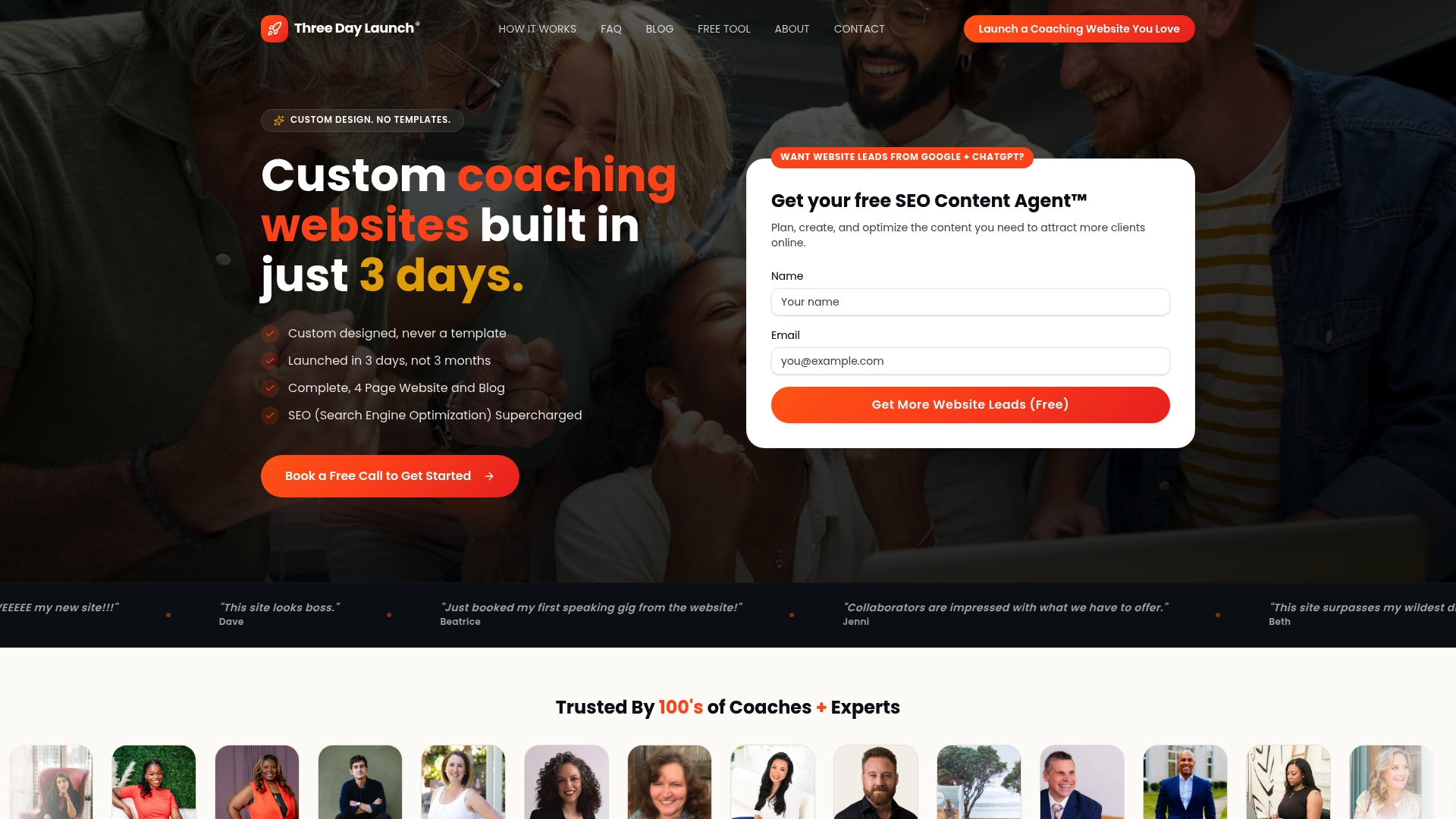
Three Day Launch was built for solopreneurs who know they need a custom site but can't afford to wait months for one. The service delivers a fully functional, multi-page custom website in 3 days, built to your brand, your audience, and your sales process. No templates. No generic layouts. No waiting.
Coaches in life, finance, health, and a dozen other fields have used Three Day Launch to launch sites that generate real organic leads within weeks. The combination of speed and professional quality means you get the business impact of custom design without the traditional timeline. If you're ready to stop fitting your brand into someone else's framework, Three Day Launch is the place to start.
FAQ
Why do solopreneurs choose custom sites over templates?
Custom sites give solopreneurs full control over branding, user experience, and lead generation. Templates force content into pre-built layouts that limit how specifically a business can speak to its ideal client.
How long does it take to see ROI from a custom website?
Businesses typically see ROI from custom web development within 8–14 months, driven by better lead conversions, improved search rankings, and lower maintenance costs.
Do custom websites rank better on Google?
Custom sites regularly score 90+ on Google PageSpeed Insights, compared to 70–80 for template sites. Google uses page speed as a ranking factor, so that gap directly affects search visibility.
Can I update a custom website myself?
Yes. Most custom sites are built on WordPress or a similar CMS, giving you a simple interface to update text, images, and pages without any coding knowledge.
What is the total cost of ownership for a custom site versus a template?
Custom sites cost more upfront but reduce long-term expenses by eliminating plugin subscriptions, theme renewals, and recurring developer fixes that template sites require over time.