SEO for New Coaches: Build Visibility and Win Clients
SEO is a client acquisition system for new coaches. Learn how niche keywords, content clusters, and trust signals turn search traffic into booked calls.
SEO, or search engine optimization, is the process of making your website show up when potential clients search for the help you offer. For new coaches, the role of SEO is not just about traffic. It is a client acquisition system that brings qualified prospects to your door while you sleep. Service pages improve rankings within 4–9 months, and consistent leads typically start flowing around the 6–12 month mark. That timeline is not a warning. It is a roadmap. Start now, and your future self will thank you.
What is the role of SEO for new coaches trying to get clients?
SEO is the difference between a website that sits quietly online and one that actively pulls in clients. When someone types "executive coach for new managers" or "health coach for busy moms" into Google, they are already looking for help. Your job is to be the answer they find.
New coaches often assume SEO is a technical puzzle reserved for developers. It is not. At its core, coaching website optimization means matching your content to the exact words your ideal clients use when they search. Get that right, and Google does the heavy lifting for you.

The payoff compounds over time. Unlike paid ads that stop the moment your budget runs out, SEO builds an asset. Every article you publish, every page you optimize, and every trust signal you add stacks on top of the last. That is why digital marketing for coaches consistently points to SEO as the highest long-term return on effort.
How do new coaches identify and target the right keywords?
Keyword selection is where most new coaches go wrong. They target broad terms like "life coach" or "business coach" and wonder why they never rank. Those terms are dominated by high-authority directories like Psychology Today and Yelp. A brand-new site cannot compete there.
Niche-targeted keywords convert 10x better than broad terms and are far more attainable for coaches with lower domain authority. That means specificity wins. Instead of "life coach," try phrases like:
- "Executive coach for first-time CEOs"
- "Career coach for nurses leaving bedside"
- "Relationship coach for divorced women over 40"
- "Finance coach for freelancers"
These phrases have lower search volume, but the people searching them are ready to hire. They are not browsing. They are deciding.
Pro Tip: Coaching demand peaks in august, according to search trend data. Plan your content calendar so your best articles are published 3–4 months before that window, giving them time to rank before high-intent season hits.
One more thing worth knowing: buyer intent matters more than search volume. A keyword with 200 monthly searches and high buyer intent will generate more booked calls than a keyword with 10,000 searches from people who are just curious. Focus on what your ideal client types when they are ready to spend money.
What content strategies help new coaches build authority and rank?
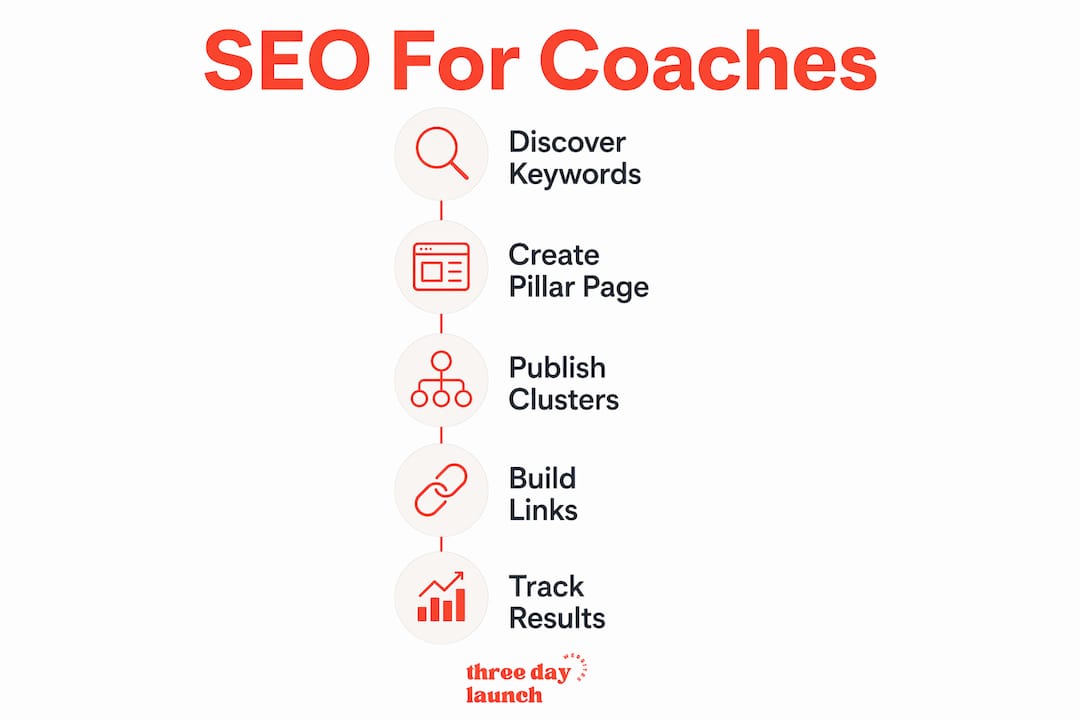
Random blog posts do not build authority. A focused content structure does. The most effective approach for coaches is the content cluster model: one pillar page covering a broad topic in depth, supported by 6–12 shorter cluster articles that each address a specific subtopic.
HubSpot reports up to 434% more indexed pages with a focused cluster strategy compared to scattered posting. More indexed pages mean more entry points for Google to send clients your way.
Here is how to structure a content cluster for a health coach:
- Pillar page: "The Complete Guide to Health Coaching for Busy Professionals"
- Cluster article: "How to eat well when you travel for work"
- Cluster article: "Why stress management is the missing piece in your health plan"
- Cluster article: "What to expect in your first health coaching session"
- Cluster article: "Health coaching vs. nutritionist: which one do you need?"
Each cluster article links back to the pillar page. That internal linking structure signals to Google that your site is an authority on the topic.
| Content type | Purpose | Posting frequency |
|---|---|---|
| Pillar page | Covers broad topic in depth | Once per niche |
| Cluster article | Targets specific subtopic | 2–4 per month |
| Service page | Converts visitors to clients | One per service offered |
| FAQ page | Captures question-based searches | Update quarterly |
Consistency in publishing 2–4 articles monthly builds authority that compounds over time. Consistency beats perfection every single time.
Pro Tip: Write your pillar page first. It gives you a home base to link cluster articles back to, and Google rewards that internal structure with faster authority gains.
How does SEO guide potential clients through their decision-making process?
A potential coaching client does not go from "I've never heard of you" to "here's my credit card" in one click. They move through stages: awareness, consideration, and decision. Your SEO content needs to meet them at each stage.
SEO must address all three decision stages to convert search traffic into booked calls. Here is what that looks like in practice:
- Awareness stage: Blog posts that answer broad questions. "Why do high-achievers feel stuck?" or "Signs you need a career coach." These attract people who are just realizing they have a problem.
- Consideration stage: Comparison and how-it-works content. "What does a life coach actually do?" or "How to choose the right executive coach." These attract people actively evaluating their options.
- Decision stage: Service pages, testimonials, and case studies. "Work with me" pages with clear outcomes, real client results, and a direct call to book a call. These convert.
Most new coaches only create awareness content. They write blog posts but never build out the service pages and trust signals that close the deal. That is a funnel with a hole in the bottom.
"SEO focused on trust and authority drives predictable client acquisition rather than traffic spikes."
Your coaching website needs all three layers working together. Awareness content brings people in. Consideration content builds trust. Decision content gets them to book.
Let's Launch Your Strategic Coaching Website
Your first step is to book a free call so we can get your questions answered.
Book A Free CallWhat foundational SEO elements should new coaches set up first?
Before you write a single blog post, get your foundation right. Technical SEO is important, but entity clarity comes first. Google needs to know who you are, what you do, and where you operate before it will rank you for anything.
Entity clarity and trust signals are foundational before scaling any SEO effort. Start with these non-negotiables:
- One primary website. Do not split your presence across multiple domains. Pick one URL and commit to it.
- Google Business Profile. Claim it, verify it, and fill out every field. Local SEO through Google Business Profile delivers visibility even for virtual coaches targeting specific cities or regions.
- Consistent NAP. Your Name, Address, and Phone number must match exactly across your website, Google Business Profile, and any directory listings. Inconsistencies confuse Google and hurt rankings.
- Clear positioning on your homepage. Your headline should say who you help, what outcome you deliver, and how. "I help burned-out nurses find fulfilling careers outside the hospital" beats "Welcome to my coaching practice" every time.
The EEAT framework (Experience, Expertise, Authoritativeness, Trustworthiness) guides how Google and AI assistants evaluate your content in 2026. Vague, inspirational copy does not cut it. Verifiable credentials, specific client outcomes, and named methodologies do.
Pro Tip: Add an "About" page that reads like a credential document, not a biography. List your certifications, your coaching approach by name, and one or two specific client results. That page alone can lift your EEAT score significantly.
Key takeaways
SEO for new coaches is a client acquisition system, not a traffic experiment. Build it with niche keywords, structured content, and trust signals, and it pays dividends for years.
| Point | Details |
|---|---|
| SEO is a long-term asset | Consistent leads typically start at 6–12 months; start building now, not later. |
| Niche keywords win | Specific phrases like "coach for first-time CEOs" convert far better than broad terms. |
| Content clusters build authority | One pillar page plus 6–12 cluster articles generates significantly more indexed pages. |
| Funnel-based content converts | Address awareness, consideration, and decision stages to turn visitors into booked calls. |
| Foundation before content | Claim your Google Business Profile and establish entity clarity before scaling blog output. |
What new coaches actually get wrong about SEO
We have worked with a lot of coaches, and the pattern is almost always the same. They pour energy into writing blog posts, then check their traffic stats every week wondering why nothing is happening. The real problem is not the content. It is the strategy underneath it.
The coaches who get SEO right treat it like a client acquisition funnel, not a content calendar. They ask: "What does my ideal client search for the week before they decide to hire a coach?" Then they build content that answers that exact question. Everything else is secondary.
The other thing I see constantly is coaches chasing vanity metrics. Page views feel good. Booked calls pay the bills. A single well-optimized service page targeting "executive coach for tech founders in Austin" will outperform 50 generic blog posts about mindset. Specificity is the whole game.
Patience is also non-negotiable. SEO does not reward sprints. It rewards consistency. Publishing two solid articles a month for a year beats publishing 20 articles in january and going quiet. The coaches who stick with it past the six-month mark are the ones who wake up one day to a full calendar from organic traffic alone. That is the goal. It is absolutely reachable.
How Three Day Launch helps coaches build an SEO-ready website
Getting your SEO foundation right starts with having a website that is actually built for it. A site with clear service pages, proper structure, and fast load times gives every piece of content you create a real shot at ranking.
Three Day Launch builds custom coaching websites in just three days, with SEO best practices baked in from the start. No templates, no guessing about page structure, and no waiting months for a developer to finish. Coaches across life, health, and finance niches have reported real growth in organic traffic and client inquiries shortly after launch. If you are ready to build the online presence your coaching business deserves, Three Day Launch is built for exactly that.
FAQ
How long does SEO take to work for a new coaching website?
Service pages typically improve in rankings within 4–9 months, with consistent client leads starting around the 6–12 month mark. Starting early is the only way to shorten that timeline.
What keywords should a new coach target for SEO?
Target niche-specific phrases that reflect buyer intent, such as "career coach for teachers" or "health coach for new moms." These convert far better than broad terms dominated by high-authority directories.
Does a virtual coach need local SEO?
Yes. Claiming and optimizing a Google Business Profile helps virtual coaches appear in map packs and capture high-intent leads searching in specific cities or regions.
What is EEAT and why does it matter for coaches?
EEAT stands for Experience, Expertise, Authoritativeness, and Trustworthiness. Google and AI assistants use this framework to evaluate coaching content, so verifiable credentials and specific client results are required to rank well in 2026.
How often should a new coach publish content for SEO?
Publishing 2–4 articles per month consistently builds authority faster than irregular bursts. Steady output compounds over time and signals to Google that your site is active and credible.