What Is a Coaching Intake Page? Your 2026 Guide
A coaching intake page is a structured pre-session questionnaire that helps coaches prepare, build trust, and turn discovery calls into focused, personalized coaching work.

A coaching intake page is a structured questionnaire clients complete before their first session, giving coaches the background they need to show up prepared. Think of it as your pre-session briefing. Instead of spending the first 20 minutes of a paid call asking "So, tell me about yourself," you already know the essentials. The industry standard term for this tool is the coaching intake form, and it does two jobs at once: it prepares the coach and signals to the client that your process is structured and purposeful. Platforms like ClickCoach and Simply.Coach have built intake form tools directly into their onboarding flows because coaches who skip this step consistently waste session time on basics.
What is a coaching intake page, exactly?
A coaching intake page is a structured questionnaire clients complete before session one to help coaches gather background, goals, challenges, and expectations up front. That definition matters because it draws a clear line between an intake page and a generic contact form. A contact form captures a name and email. An intake page captures the information a coach actually needs to do their job well.
The intake page sets a professional tone from day one. When a client fills out a thoughtful questionnaire before your first call, they arrive with their thoughts organized. You arrive with context. That combination makes session one feel like session three.

Coaches across life coaching, health coaching, and financial coaching all use intake forms, though the specific questions differ by niche. A life coach might ask about values and limiting beliefs. A financial coach might ask about income, debt, and money mindset. The format is the same; the content is tailored to the work.
What information does a coaching intake page typically collect?
The most effective coaching client questionnaires focus on three core areas: client goals with a timeframe, the context behind those goals, and what the client has already tried. Those three categories give you a complete picture without overwhelming the client with questions.
Here is a breakdown of what to include in an intake form:
- Client goals and desired outcomes. Ask what the client wants to achieve and by when. Specificity here saves you from vague first sessions.
- Current situation and context. What is happening in their life or business right now that makes this goal relevant? Context shapes how you coach.
- Previous attempts or coaching history. Have they worked with a coach before? What worked? What did not? This prevents you from repeating approaches that already failed.
- Scheduling preferences and logistics. Scheduling details like availability and preferred communication methods reduce the back-and-forth that clogs up onboarding.
- Preferred learning and communication style. Some clients want direct feedback. Others need more encouragement. Knowing this upfront changes how you deliver your coaching.
The importance of intake forms comes down to one word: preparation. You cannot personalize a session you know nothing about.
Pro Tip: Keep your intake form under 10 questions. Long or bureaucratic forms reduce completion rates. Stick to the questions you will actually use in session one.
One more design decision worth making: separate required from optional questions. Limit required fields to one or two essentials, like the client's main goal. Optional questions give motivated clients a chance to share more without blocking less detail-oriented clients from completing the form.
When and how should you share your coaching intake form?
Timing your intake form correctly is just as important as what you put in it. Send it too late and clients rush through it. Send it too early and they forget about it.
The best practice is to send intake forms at least two days before the first session, or better yet, at the moment of booking. Here is why the booking moment works so well:
- Capture clients at peak intent. The moment someone books a session is the moment they are most motivated. Collecting intake at booking reduces drop-off because you catch clients before that initial excitement fades.
- Give yourself review time. Receiving responses two or more days before session one gives you time to read, reflect, and plan. You show up to the call with specific questions already prepared.
- Reduce scheduling friction. Embedding the intake into your booking flow means clients complete it in one sitting rather than hunting for a separate link later.
- Set expectations early. A client who fills out a thoughtful form before session one already understands that your coaching process has structure. That expectation carries into the work itself.
Pro Tip: Tools like ClickCoach let you embed intake forms directly into your booking flow, so clients complete the questionnaire as part of the same process as scheduling. No separate emails, no chasing.
The coaching consultation page on your website is often where this intake process begins. A well-designed consultation page explains what the intake form is for, sets expectations about the process, and makes completing the form feel like a natural next step rather than homework.
How does a coaching intake page fit within the full onboarding process?
A coaching intake page is one piece of a larger onboarding sequence. Onboarding as a whole includes contracts, payment processing, welcome emails, the intake form, and session one setup. The intake form is the information-gathering engine within that sequence. It does not replace the other steps; it makes them more effective.
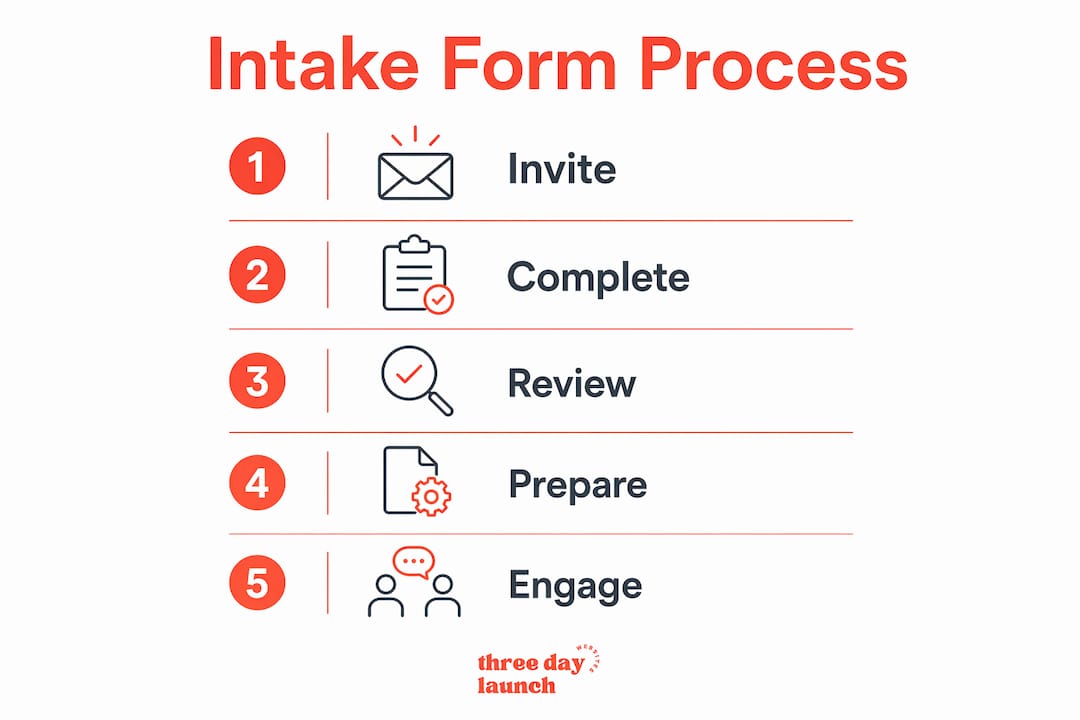
Here is how a complete onboarding flow typically looks:
- Contract and payment. Clients sign your coaching agreement and complete payment before anything else. This protects both parties and confirms commitment.
- Welcome email. A warm, clear welcome email sets the tone and delivers next steps, including a link to the intake form.
- Coaching intake form. Clients complete the questionnaire at their highest engagement moment, ideally right after booking.
- Coach review. You read the responses before session one and identify the themes, goals, and questions you want to address.
- Session one. You open with something specific from the intake responses, which immediately builds rapport and trust.
The intake form sits in the middle of this sequence for a reason. It feeds directly into session one preparation. Intake pages also function as client filters, helping coaches identify whether a prospective client is a good fit before the first session even happens. That dual role, preparation and qualification, makes the intake form one of the highest-value tools in your onboarding process.
Minimal vs. comprehensive intake forms: which works better?
Not every coach needs the same intake structure. The right format depends on your coaching niche, session length, and client type.
| Format | Questions included | Best for | Trade-off |
|---|---|---|---|
| Minimal (3–5 questions) | Main goal, timeline, biggest obstacle | Discovery calls, short programs | Less context for coach |
| Standard (6–8 questions) | Goals, context, history, style preferences | Ongoing 1:1 coaching | Balanced depth and completion |
| Comprehensive (9–10 questions) | All of the above plus logistics and background | High-ticket or long-term programs | Risk of lower completion if not designed well |
Let's Launch Your Strategic Coaching Website
Your first step is to book a free call so we can get your questions answered.
Book A Free CallThe minimal format works well for a first discovery call where you want a snapshot, not a full picture. The standard format suits most ongoing coaching relationships. The comprehensive format makes sense for high-ticket programs where deep personalization justifies the extra questions.
The key insight here: longer is not better. A 10-question form that every client completes beats a 20-question form that half your clients abandon. Keeping forms concise directly improves both completion rates and the quality of the responses you receive.
Key Takeaways
A coaching intake page is the single most effective tool for turning a first session from a get-to-know-you call into focused, personalized coaching work.
| Point | Details |
|---|---|
| Define the intake page clearly | It is a structured questionnaire clients complete before session one, not a generic contact form. |
| Limit required questions | Keep required fields to one or two essentials to maximize completion rates. |
| Time it at booking | Embedding the form in the booking flow captures clients at their highest intent moment. |
| Use responses in session one | Open your first call with something specific from the intake to build instant rapport. |
| Fit it into full onboarding | The intake form works alongside contracts, welcome emails, and session prep, not instead of them. |
What I have learned from watching coaches skip this step
Here at Three Day Launch, we have built websites for coaches across life, health, finance, and business niches. The coaches who struggle to convert discovery calls into paying clients almost always share one thing: they have no intake process. They show up to calls cold, spend half the session gathering basic context, and leave the client feeling like the session was unfocused.
The coaches who thrive treat the intake form as a non-negotiable. They review responses the night before, highlight two or three themes, and open session one with something like, "You mentioned that you have tried to address this twice before and it has not stuck. I want to start there." That one sentence, pulled directly from the intake form, tells the client you actually read what they wrote. That builds more trust in 10 seconds than any amount of polished branding.
The mistake I see most often is coaches treating the intake form as a formality. They create it once, never update it, and never actually use the responses. The form becomes a checkbox rather than a tool. If you are not reading the responses before every session, the form is not doing its job.
The other common mistake is making the form too long out of a desire to be thorough. Thoroughness is good. Scaring clients off with a 25-question form before they have even started working with you is not. Start with five focused questions. Add more only when you find yourself consistently wishing you had asked something specific.
— Three Day Launch
Your coaching website should do the heavy lifting
A great intake form only works if clients actually find it and trust it enough to complete it. That is where your website comes in. Coaches who have a well-designed coaching website see higher intake form completion rates because the site itself builds credibility before the client ever reads the first question.

Three Day Launch builds custom coaching websites in three days, with intake pages and onboarding flows built in from the start. No templates, no months-long timelines. Coaches working with Three Day Launch have reported significant increases in leads and client conversions from organic traffic shortly after launch. If your intake page is buried in a clunky website, the best questionnaire in the world will not save your conversion rate. A site that reflects your professionalism makes every part of your onboarding process work harder. Check out coach website features that actually convert clients to see what a high-performing coaching site looks like.
FAQ
What is a coaching intake page?
A coaching intake page is a structured questionnaire clients complete before their first coaching session. It collects goals, context, history, and preferences so the coach can prepare a personalized session.
How long should a coaching intake form be?
A coaching intake form should contain no more than 10 questions, with only one or two marked as required. Shorter forms have higher completion rates and produce more useful responses.
When should I send my coaching intake form?
Send the intake form at the moment of booking or at least two days before session one. Collecting it at booking captures clients when their motivation is highest and reduces drop-off.
What is the difference between a coaching intake page and a contact form?
A contact form collects basic details like name and email. A coaching intake page collects the substantive information a coach needs to prepare for session one, including goals, challenges, and communication preferences.
Do I need a website to use a coaching intake form?
You do not need a website to use an intake form, but embedding it in a professional coaching website significantly increases trust and completion rates. Platforms like ClickCoach also offer standalone intake form tools within their booking systems.